


If you have acne-prone skin, then you are always looking for effective ways to prevent and minimize your breakouts. As LED light therapy becomes more accessible through many devices in the home. So many acne-prone people want to know if it can help tame their breakouts. And that’s a reasonable goal, because LED isn’t just “a spa trend.” There is actual clinical data behind a combination of blue and red light for mild to moderate acne. But it’s also easy to get disappointed if you expect it to work like a powerful prescription or if your device/routine doesn’t match the studies that actually tested it.
Why “acne LED” is confusing the internet
If you’ve done a quick search on LEDs to manage your acne, you may have seen mixed results. And the mixed positive and negative feedback can make it confusing to decide if LEDs can really help. Most of the confusion comes from three things:
- “Acne” is not a problem. Inflammatory pimples behave differently than blackheads.
- Not all LED devices are comparable. Wavelength and dose matter more than “number of bulbs”.
- The LED is phased. Even when it works, it tends to work for weeks of continuous use, not overnight.
How LED Light Therapy Can Improve Acne (Simple Mechanism)
Although LED light therapy is becoming increasingly popular, it is not a new skin care treatment. LED light therapy masks and hand-held devices for home treatments are based on established science. they just become much more affordable. So let’s talk about the science behind LEDs for acne treatment.
Blue light: targets acne bacteria (and some inflammation)
Blue light (about 415–460 nm) reaches mainly the upper layers of the skin. Its main action is that it is absorbed by the porphyrins produced by Cutibacterium acnesa type of bacteria that causes acne. Porphyrins are small molecules that are important for keeping bacteria alive. When these small molecules absorb blue light, it triggers a photochemical reaction that creates reactive oxygen species, which can harm bacteria.
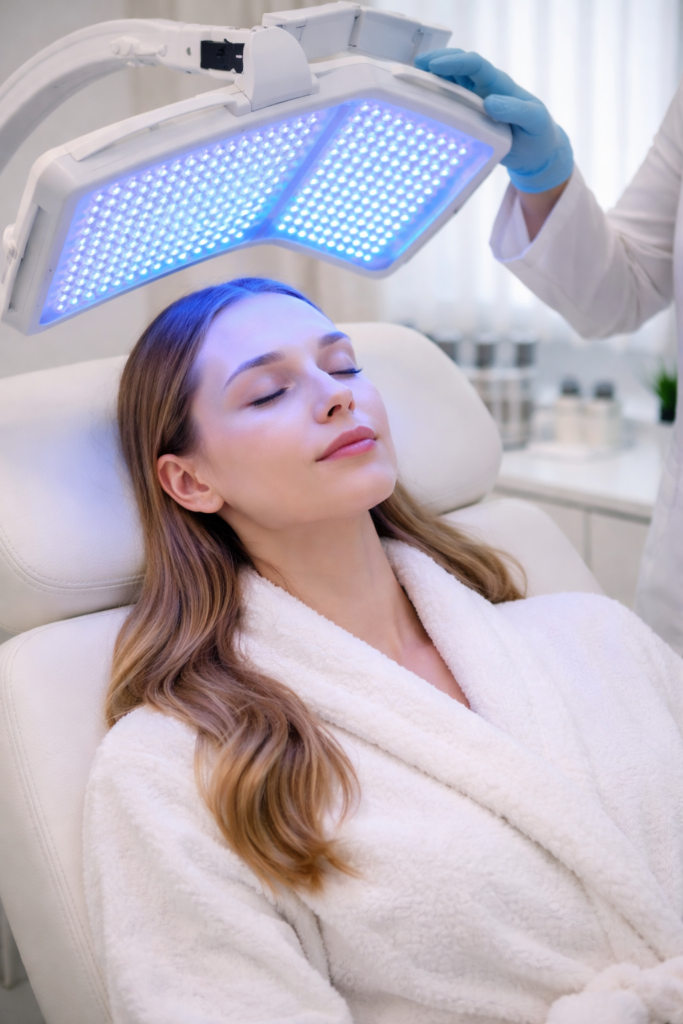
Blue light can also shift inflammatory signals in the skin, which can help calm redness over time.
Red light: supports anti-inflammatory effects deeper in the skin
Red light (around 630–660 nm) penetrates deeper than blue and is usually combined with blue for acne. In the white paper, red light is described as complementing blue by helping calm inflammation and affecting deeper targets (including oil-producing sebaceous glands that feed bacteria).
Why blue and red together are important: Blue addresses bacteria-related pathways, while red supports anti-inflammatory effects, so the combination tends to outperform either one alone.
What the Clinical Evidence Shows About At-Home LED Acne Devices
There are several scientific studies that show results you can expect from an at-home LED device if you’re trying to help manage your acne. Scientific studies show that at-home LED devices actually help people manage mild to moderate acne. Clinical studies prove that consistent use of these devices results in clearer skin, especially when it comes to red, painful bumps. For example, a seven-week study found that nearly 9 out of 10 people saw their acne improve after using an LED mask just four times a week. Another test showed that a wearable device used twice a day reduced red spots by 77%, while a dummy device did nothing at all. A large 2025 review of several different studies confirmed that while red and blue lights work, using them together gives the best results. Overall, these devices are a great choice for anyone looking to improve their acne management routine.
Which LED helps the most (and which helps the least)
Most responsive: inflammatory acne
Research shows that at-home LED devices are more effective on inflamed pimples. Inflamed pimples tend to respond first, often with less redness and smaller lesions after a few weeks. This is related to the mechanism we discussed earlier, where blue light is absorbed by the small molecules, porphyrin that are important for keeping bacteria alive.
Less responsive: black spots and closed comedies
Non-inflammatory lesions are less responsive to at-home LED treatments, in part because comedones lack the porphyrin targets that blue light acts on.
Practically speaking, if your acne is mostly clogged pores with a few inflamed bumps, LED might be a “nice extra” but it’s less likely to be the primary solution.
What Success “At Home” Typically Requires (Dosage + Program)
Home devices generally have lower power than professional panels, so positive results depend on constant repetition of sessions. Most studies show that favorable results come when the device is used for about 10-20 minutes per session, at least 3-4 times a week. Studies also describe a realistic improvement timeline of 4-8 weeks.
Why results vary so much between people
So, if the science is so convincing about home LED devices for acne, why are there such mixed results? Even with good science, acne results vary because:
- The device must be “FDA cleared,While there are many affordable options that are not FDA approved, meaning they have no evidence to support their effectiveness.
- Your acne type may not match the strengths of the LED. Inflammatory acne tends to respond better to commodes.
- Dosage and compliance vary. The studies that worked used frequent sessions over weeks.
How to Use LED for Acne at Home (A Realistic Routine)
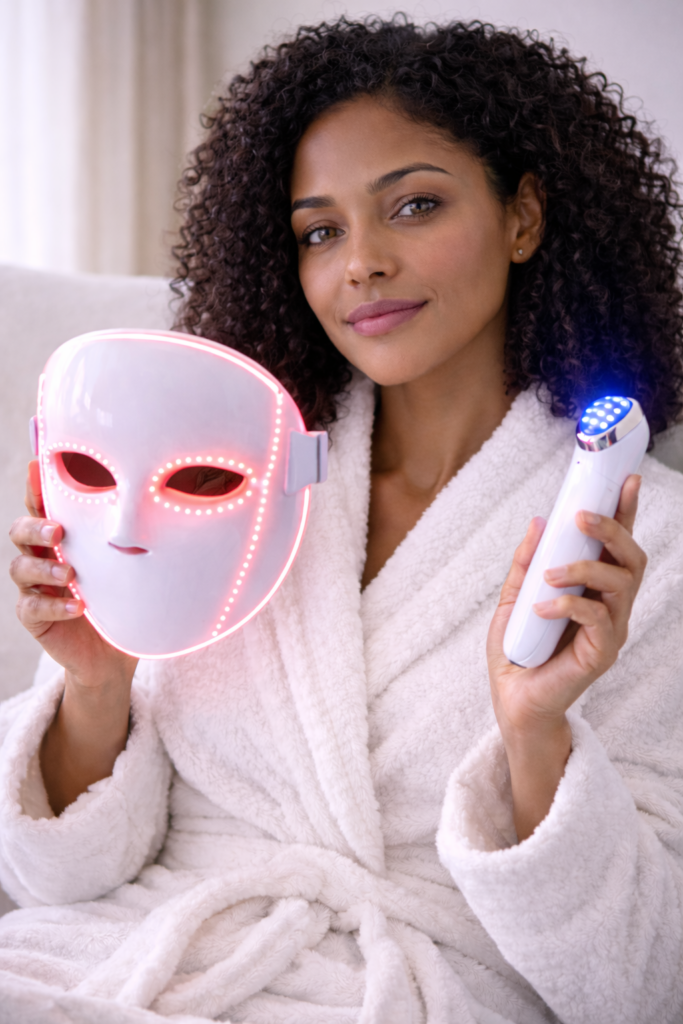
If you’re considering an at-home LED mask to help manage your acne, here’s a good way to start incorporating it into your research-based at-home routine to maximize your results.
- Frequency: 3-4 times/week at least (often more consistent = better)
- Session duration: 10-20 minute sessions for each use
- Timeline: judge results after ~6-8 weeks of consistent use, not after a few uses
- Maintenance: Wipe the mask with alcohol after each use.
LED Reep at-home masks are a helpful player in your acne management skincare routine. They are useful alongside standard skin care and not as a substitute for anything else.
So at-home LED masks can help manage acne, but are they safe…
LED masks are generally described as non-thermal and well tolerated when used as directed. Studies show only mild temporary effects such as slight redness or dryness reported in some users.
Additionally, there are a few precautions associated with acne:
1) Protect your eyes (especially with blue light)
For all LED home appliances, eye protection is vital. In particular, blue light at high intensity can damage your retinal cells.
2) Avoid LED lights if you are taking drugs that cause photosensitivity (unless your clinician says okay)
Clinical trials excluded subjects using photosensitizers. The post lists examples (including certain antibiotics and isotretinoin) and advises medical advice before using an LED mask if you are taking these medications.
3) Skin prone to pigmentation: be careful with blue light
If you’re prone to pigmentation, there’s some evidence that blue light can trigger melanin production in darker skin and can worsen melasma or post-inflammatory hyperpigmentation with overexposure. He suggests melasma-prone users avoid blue modes and focus on red/NIR if using LEDs at all.
How to Choose an At-Home LED Device for Acne (Without Chasing ‘Best of Lists’)
Instead of shopping by brand hype, shop by “does this fit the bill?”
I’m looking for:
- Blue and red wavelengths used in edge tests (415 nm blue + ~ 633 nm red)
- FDA cleared for acne when possible
- A program that fits your lifebecause consistency leads to results (10–20 minutes, many days/week)
Do not gain excess weight:
- “LED Number” (not the same as Dose)
- extra colors with weak elements (nice, not the main acne story)
Summary: the ‘realistic promise’ of at-home LED light therapy for acne
Based on the evidence, at-home blue and red LED therapy can be a legitimate acne-supporting tool in your skin care routine.
If you want the broadest frame to judge any at-home LED claim for common skin care concerns (acne, anti-aging, pigmentation), start with the center.
[Related: at-home LED light therapy devices, what they actually do and how to judge whether it’s worth it]
If you find this kind of evidence-based analysis useful, I share deeper analysis and updates via my email list.
References
Ablon, G. (2025). A 7-week, open-label study evaluating the efficacy and safety of 415-nm/633-nm phototherapy for the treatment of mild to moderate acne in adolescents and adults. The Journal of Clinical and Aesthetic Dermatology, 18(10), 25–32.
Barolet, D. (2018). Dual Effect of Photobiomodification on Melasma: Reduction of Hyperpigmentation and Enhanced Sun Resistance – A Pilot Study. The Journal of Clinical and Aesthetic Dermatology, 11(4), 28–34.
Goldberg, DJ, Amin, S., Russell, BA, Phelps, R., Kellett, N., & Reilly, LA (2006). Combined 633-nm and 830-nm LED skin photoaging therapy. Journal of Drugs in Dermatology, 5(8), 748-753.
Lee, SY, Park, K.-H., Choi, J.-W., Kwon, J.-K., Lee, DR, Shin, MS, Lee, JS, You, CE, & Park, MY (2007). A prospective, randomized, placebo-controlled, double-blind, and randomized clinical study of LED phototherapy for skin rejuvenation: Clinical, profilometric, histological, ultrastructural, and biochemical evaluations and comparison of three different treatment settings. Journal of Photochemistry and Photobiology B: Biology, 88(1), 51–67.
Li, L., Jiang, X., Tu, Y., Yang, Y., Zhang, X., Gu, H., & He, L. (2023). Effect of blue light on skin pigmentation in patients with melasma. Skin Research and Technology, 29(7), e13401.
Park, SH, Park, SO, & Jung, J.-A. (2025). Clinical study to evaluate the efficacy and safety of home-use LED and IRED mask for crow’s feet: A multicenter, randomized, double-blind, sham-controlled study. Medicine (Baltimore), 104(7), e41596.
Regazzetti, C., Sormani, L., Debayle, D., Bernerd, F., Tulic, MK, De Donatis, GM, Chignon-Sicard, B., Rocchi, S., & Passeron, T. (2018). Melanocytes sense blue light and regulate pigmentation through Opsin-3. Journal of Investigative Dermatology, 138(1), 171–178.
Scott, AM, Stehlik, P., Clark, J., Mackenzie, H., Grant, S., Glasziou, P., & Del Mar, CB (2019). Blue light therapy for acne vulgaris: A systematic review and meta-analysis. Annals of Family Medicine, 17(6), 545–553.
Barolet, D., & associates. (2023). Low-intensity visible and near-infrared light-induced cell signaling in skin photobiomodulation (review).
