Close Menu
Healthtost
  • News
  • Mental Health
  • Men’s Health
  • Women’s Health
  • Skin Care
  • Sexual Health
  • Pregnancy
  • Nutrition
  • Fitness
  • Recommended Essentials
What's Hot

Capable of creating warmth for every skin tone

February 3, 2026

Hopeful climate commitment can reduce mental distress

February 3, 2026

Mental Health in the Black Community: Addressing…

February 3, 2026
Facebook X (Twitter) Instagram
  • About Us
  • Contact Us
  • Privacy Policy
  • Terms and Conditions
  • Disclaimer
Facebook X (Twitter) Instagram
Healthtost
SUBSCRIBE
  • News

    Hopeful climate commitment can reduce mental distress

    February 3, 2026

    The young fall behind, the old thrive

    February 2, 2026

    Simple hemiarch surgery effective for elderly patients with aortic dissection

    February 2, 2026

    Embedded Monte Carlo and deep learning improve radiotherapy QA

    February 1, 2026

    Age shapes long-term outcomes after multiarterial CABG strategies

    February 1, 2026
  • Mental Health

    Mental Health in the Black Community: Addressing…

    February 3, 2026

    Some people gain confidence when they think things through, others lose it – new research

    February 2, 2026

    3 practical ways to improve a writer’s mental health

    January 31, 2026

    Your phone is not a weakness. It’s a distraction machine. Here’s how to regain your focus.

    January 25, 2026

    Find out how you can support people with eating and substance use disorders

    January 24, 2026
  • Men’s Health

    Testicular cancer self-examination and why it could save your life

    February 2, 2026

    25-Minute Bodyweight Functional Training Program for Beginners

    February 1, 2026

    Turning everyday eggs into powerful nutrient delivery systems

    January 30, 2026

    Affordable food can be better, both for you and the planet

    January 30, 2026

    Full Body Kettlebell Complex for Strength and Muscle Definition

    January 25, 2026
  • Women’s Health

    Prenatal care in 2026: New recommendations for healthy pregnancy

    February 1, 2026

    3 Teens Quit Social Media for a Week — and Loved It

    February 1, 2026

    Exercises for Prevention, Symptoms & Recovery

    January 31, 2026

    Cómo puedo saberlo: ¿Es tristeza o depresión?

    January 31, 2026

    Over 40 Body Rebuild – How to Build Muscle and Lose Fat

    January 30, 2026
  • Skin Care

    Capable of creating warmth for every skin tone

    February 3, 2026

    The Perfect Nighttime Skincare Routine, Edited by About Face Aesthetics

    February 1, 2026

    Cleaners that make a difference: How to choose yours

    January 30, 2026

    How to Layer Hyaluronic Toner + Serums for G – The Natural Wash

    January 29, 2026

    How to bathe my newborn – Tropical skin care

    January 29, 2026
  • Sexual Health

    A guide to a comfortable cervical check with Dr. Unsworth

    February 1, 2026

    How “Bridgerton” and the Other Romances Evolved in Their Depictions of Consent

    January 30, 2026

    Extraction, gold mining and SRHR in Kenya

    January 29, 2026

    How the Wabi-Sabi Body Frame is Rewriting Body Image Therapy — Sexual Health Alliance

    January 28, 2026

    Is an HPV vaccine enough?

    January 25, 2026
  • Pregnancy

    Is it safe to drink milk during pregnancy? What to know

    January 31, 2026

    12 Expert Answers to Your Pregnancy Yoga Questions

    January 29, 2026

    Best Pregnancy and Postpartum Fitness Course 2026

    January 27, 2026

    The best baby travel products for visiting family

    January 26, 2026

    The top 3 pregnancy facials that are safe and effective

    January 25, 2026
  • Nutrition

    5 Ways You’re Sabotaging Your Metabolism

    February 2, 2026

    How to Save Money on Travel • Kath Eats

    February 1, 2026

    How low can LDL cholesterol go on PCSK9 inhibitors?

    January 31, 2026

    Signs that your body is ready to reset

    January 31, 2026

    Healthy Pakistani Recipes: Low-Oil Versions of Beloved Classics

    January 30, 2026
  • Fitness

    Can your customers actually do what you want them to do? – Tony Gentilcore

    February 2, 2026

    7 Essential Mental Health Tips for Healthy Aging

    February 2, 2026

    Beginner-friendly menopause workouts to build strength

    February 1, 2026

    Best Cereals for Weight Loss: 7 Healthy, Satisfying Choices

    February 1, 2026

    Inside the OPEX Mentorship Method Week 7: Lifestyle & Nutrition

    January 31, 2026
  • Recommended Essentials
Healthtost
Home»Women's Health»Is it normal to have period clots during your period?
Women's Health

Is it normal to have period clots during your period?

healthtostBy healthtostMarch 17, 2024No Comments6 Mins Read
Facebook Twitter Pinterest LinkedIn Tumblr Reddit WhatsApp Email
Is It Normal To Have Period Clots During Your Period?
Share
Facebook Twitter LinkedIn Pinterest WhatsApp Email

Despite the fact that there is a month in and month out period, there are still some questions that remain unanswered about this time of the month.

This could be partly because one did not receive sufficient (or any) education about the menstrual cycle at home or at school, or because one notices something during “that time of the month” that is unusual or perhaps even frightening.

Like menstrual clots – are they normal and why do they happen?

During your monthly period, you uterine the lining is shed which means blood is expelled through it sinus.

This lining consists of blood, blood by-products, mucus and tissue.

This blood and tissue is quite thick, so the body releases anticoagulants that help thin the blood to make it easier to pass through.

But, if your blood flow exceeds your body’s ability to produce anticoagulants, menstrual clots occur.

As Salena ZanottiMD, says:

“Blood clots will form whenever you have a certain amount of blood sitting there. Blood clots are supposed to happen to some degree, like when you cut yourself. But with period clots, what happens is if you have enough bleeding, it collects inside your uterus and as it sits there it will form a clot.”

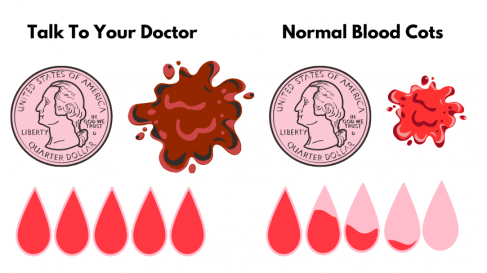
If you’re someone who experiences menstrual clots, it’s a good idea to see a specialist if:

  • You pass many blood clots that are larger than a quarter
  • You have heavy menstrual bleeding (change tampons or pads every two hours or less) for several hours

“Normal blood clots are usually:

  • Smaller than a quarter
  • Rare
  • It happens near the start of your period
  • Intense or dark red in appearance

blood clots during periods

Underlying causes of menstrual clots

Now that we know what happens inside the body when menstrual clots form and are released, are there any underlying causes we should be aware of?

Indeed, there are some natural and hormonal factors that can affect blood flow and the formation of blood clots.

Obstructions of the uterus

If someone has a condition that enlarges the uterus, additional pressure could be placed on the uterine wall. This could lead to heavier menstrual bleeding and clots.

Obstructions can also affect the uterus’ ability to contract. This means that it will take longer for the blood to leave the vagina to start pooling in the uterine cavity and forming clots.

Hormone imbalance

Throughout the menstrual cycle, hormones are constantly changing, rising and falling. That doesn’t mean there is one imbalance however. In fact, this combination of hormonal changes makes the perfect situation for conception.

But if someone suffers from an imbalance of hormones (perhaps from conditions such as perimenopausestress, significant weight loss or gain), then there could be a change in how much blood is expelled and whether or not it forms clots.

Adenomyosis

This condition causes the lining of one’s uterus to grow into the muscular wall of the uterus. And when it does, the uterus can grow up to two to three times its normal size.
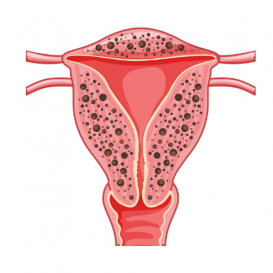
During adenomyosis, the endometrial lining and uterine wall may be much thicker than normal. This, in turn, can lead to heavier periods and blood clotting.

Enlarged uterus

If someone has a bigger one matrix (often after pregnancy), has more room for blood to pool before being expelled.

This means that blood clots can form as the blood sits inside the uterus, waiting to leave the body.

Failure

In the unfortunate event of a failureit is common to pass a lot of blood and blood clots.

But if a person doesn’t know they’re pregnant, they might just think it’s a heavy period.

Thyroid issues

Your thyroid is a gland in your neck that is responsible for producing and distributing hormones. Thus, if one experiences a thyroid conditionit can mean chaos for their menstrual cycle.
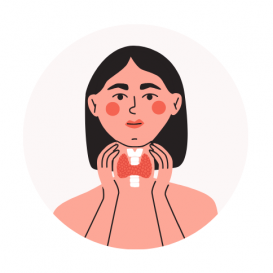
Some thyroid conditions include hyperthyroidism and hypothyroidism (when the body produces too much or too little thyroid hormone).

Endometriosis

Endometriosis it affects about 10% of women worldwide. It is a condition that causes the tissue lining the uterus to grow outside the uterus.

If someone is living with endometriosis, they may experience heavier and more painful periods that are accompanied by blood clots.

How to diagnose menstrual clots

If you frequently experience period clots that are larger than a quarter, the first step would be to see your healthcare provider.

They will ask you many questions about your cycle as well as things that may affect your cycle.

For example, you may be asked if you’ve ever had pelvic surgery if you use contraceptionor if you have ever become pregnant.

After that, they may do some blood tests to look for any hormonal imbalances. And/or they may perform an imaging test (such as an MRI or ultrasound).

How to treat period clots

There are a few solutions that can be effective in reducing or stopping menstrual clots:
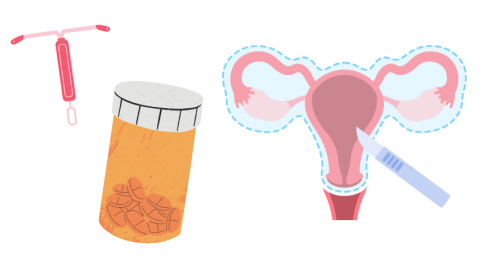
  • Hormonal contraceptives: If someone is taking hormonal contraceptives, the growth of the lining of the uterus could be inhibited. An intrauterine device (IUD), for example, can reduce the amount of period blood by up to 90%. And the birth control pill could reduce it by as much as 50%.
  • Medication: The drug belonging to the class of drugs known as antifibrinolytics could have a positive effect on period coagulation. A health care provider may also suggest that you take non-steroidal anti-inflammatory drugs, which can help with less bleeding and more comfort.
  • Surgery: A dilation and curettage procedure (D and C) is sometimes done after the birth of the child or a miscarriage. It can also be done as a means to discover the cause of heavy menstruation and blood clots. This procedure will not cure heavy bleeding, but it could provide less bleeding for a few months. Another surgery that some may choose is a hysterectomy. This is when the uterus is removed and one will not be able to conceive or have monthly periods.

So while period clots can be a cause for concern, there are a few ways a professional could help.

The bottom line; If you start to notice that your periods are becoming much heavier or that you are experiencing (more) large blood clots, it is recommended that you seek medical treatment.

clots Normal Period
bhanuprakash.cg
healthtost
  • Website

Related Posts

Prenatal care in 2026: New recommendations for healthy pregnancy

February 1, 2026

3 Teens Quit Social Media for a Week — and Loved It

February 1, 2026

Exercises for Prevention, Symptoms & Recovery

January 31, 2026

Leave A Reply Cancel Reply

Don't Miss
Skin Care

Capable of creating warmth for every skin tone

By healthtostFebruary 3, 20260

There’s something quietly transformative about finding a makeup product that just works. No overthinking, no…

Hopeful climate commitment can reduce mental distress

February 3, 2026

Mental Health in the Black Community: Addressing…

February 3, 2026

Can your customers actually do what you want them to do? – Tony Gentilcore

February 2, 2026
Stay In Touch
  • Facebook
  • Twitter
  • Pinterest
  • Instagram
  • YouTube
  • Vimeo
TAGS
Baby benefits body brain cancer care Day Diet disease exercise finds Fitness food Guide health healthy heart Improve Life Loss Men mental Natural Nutrition Patients People Pregnancy protein research reveals risk routine sex sexual Skin study Therapy Tips Top Training Treatment ways weight women Workout
About Us
About Us

Welcome to HealthTost, your trusted source for breaking health news, expert insights, and wellness inspiration. At HealthTost, we are committed to delivering accurate, timely, and empowering information to help you make informed decisions about your health and well-being.

Latest Articles

Capable of creating warmth for every skin tone

February 3, 2026

Hopeful climate commitment can reduce mental distress

February 3, 2026

Mental Health in the Black Community: Addressing…

February 3, 2026
New Comments
    Facebook X (Twitter) Instagram Pinterest
    • About Us
    • Contact Us
    • Privacy Policy
    • Terms and Conditions
    • Disclaimer
    © 2026 HealthTost. All Rights Reserved.

    Type above and press Enter to search. Press Esc to cancel.