


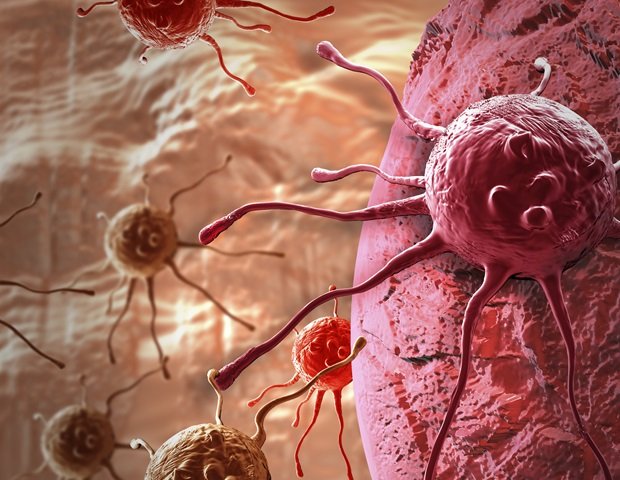
The MYC cancer gene cloaks tumors by suppressing the alarm signals that normally activate the immune system. This finding from a new study offers a promising way to improve existing cancer treatments as well as develop new ones.
Could this signal a change in the way we think about cancer treatment? At least in the lab, the evidence suggests it might be. An international research team has succeeded in deciphering a key mechanism that controls the growth of pancreatic cancers. Scientists have identified a possible central mechanism by which cancer cells protect themselves from attack by the body’s own immune system. Blocking this mechanism resulted in the dramatic reduction of tumors in experimental animals.
A look at the central driver of cell division
The results of the study have now been published in Cell. The research was mainly carried out by Leonie Uhl, Amel Aziba and Sinah Löbbert, together with other collaborators from the University of Würzburg (JMU), the Massachusetts Institute of Technology (USA) and the University Hospital Würzburg.
The study was led by Martin Eilers, Chair of Biochemistry and Molecular Biology at JMU, as part of the Cancer Grand Challenges KOODAC team. The project was part-funded by Cancer Research UK, the Children Cancer Free Foundation (Kika) and the French National Cancer Institute (INCa) as part of the Cancer Grand Challenges initiative. Additional funding came from an advanced grant from the European Research Council awarded to Martin Eilers.
In their study, the researchers focused on a specific protein that has long been known in cancer research: the MYC oncoprotein. “In many types of tumors, this protein is one of the central drivers of cell division and therefore uncontrolled tumor growth,” explains Martin Eilers. However, a critical question remained unanswered: How do tumors with high MYC activity manage to evade the body’s immune defenses? Although MYC-driven tumors grow very rapidly, they often remain invisible to the immune system.
A second face of the cancer gene
The recently published study provides the answer to this question. The key discovery made by the international research team is that MYC has a dual function. In addition to its known role of binding to DNA and activating growth-promoting genes, it can change its function when the cell is under stress. Under the chaotic conditions of rapidly growing tumors, MYC takes on a new function: instead of binding to DNA, it binds to newly formed RNA molecules.
This binding to RNA has far-reaching consequences: several MYC proteins form dense clusters, known as polymers, which act like molecular condensates. These ‘droplets’ act as collection points, specifically attracting other proteins – particularly the exosome complex – and bringing them together in one place.
The exosome complex then breaks down cellular waste in a highly targeted manner – mainly so-called RNA-DNA hybrids. These are defective products of gene activity and usually act as a strong alarm signal inside the cell, signaling to the immune system that something is wrong.
How MYC tricks the immune system
This is precisely where MYC’s camouflage function comes into play. By orchestrating the degradation of RNA-DNA hybrids with the help of exosome complexes, it eliminates alarm signals before they can activate the immune defense. As a result, the downstream signaling chain does not even start. The tumor remains invisible to the immune cells.
The researchers were able to demonstrate that an RNA-binding domain within the MYC protein is responsible for this camouflage. Importantly, this region is not required for MYC’s growth-promoting function, namely its ability to bind to DNA. The two functions—stimulating growth and tricking the immune system—are mechanistically distinct.
A targeted antitumor knockdown in an animal model
The next step was obvious: MYC proteins with a genetically engineered RNA-binding domain should no longer be able to call the exosome for help and block the alarm pathway. Indeed, the implications of this discovery were dramatic in corresponding experiments in animal models: “While pancreatic tumors with normal MYC increased in size 24-fold within 28 days, tumors with defective MYC protein collapsed over the same period and shrank by 94 percent—but only if the animals had an inactive immune system.” of the study.
Prospects and therapeutic possibilities
These results open promising new avenues for cancer treatment. Previous attempts to completely block MYC have proven difficult because the protein is also important for healthy cells. The newly discovered mechanism now offers a much more specific target.
“Instead of completely inactivating MYC, future drugs could specifically inhibit only its ability to bind RNA. This would potentially leave its growth-promoting function intact, but lift the tumor’s cloak of invisibility,” explains Eilers. The tumor would thus again become visible and vulnerable to the immune system.
However, the scientist warns that there is still a long way to go before a corresponding treatment is ready on the market. The next step is to elucidate exactly how immune-stimulating RNA-DNA hybrids are transported out of the cell nucleus and how MYC RNA binding affects the immediate tumor environment.
Cancer Grand Challenges exists to support international groups like KOODAC who are pushing the boundaries of what we know about cancer. Research like this shows how uncovering the mechanisms tumors use to hide from the immune system can open up new possibilities, not only for adult cancers but also for childhood cancers that are the focus of the KOODAC team. It is an encouraging example of how international collaboration and diverse expertise can help tackle some of the most difficult challenges in cancer research.”
Dr David Scott, Director of Cancer Grand Challenges
Cancer Grand Challenges
Founded in 2020 by two of the world’s biggest supporters of cancer research: Cancer Research UK and the National Cancer Institute, Cancer Grand Challenges supports a global community of diverse, world-class research teams to come together, think differently and tackle some of cancer’s toughest challenges. These are the obstacles that continue to block progress, and no one scientist, institution or country will be able to solve them alone. With prizes of up to £20 million, Cancer Grand Challenge teams have the opportunity to break traditional boundaries of geography and discipline to make the progress we urgently need against cancer.
Source:
Journal Reference:
