


Concussion Legacy Foundation
Author: Samantha Bureau, PhD
In September, we’re coming together to raise awareness about concussions so more people and families know what to do if they or a loved one sustains one.
A concussion is a type of traumatic brain injury, or TBI, caused by a hit, bump, or jolt to the head, or by a blow to the body that causes the head and brain to move rapidly back and forth. While concussions are usually not life-threatening, they should still be taken seriously, as the effects of a concussion can be life-changing.
This Concussion Awareness Month, we especially want to raise awareness that concussions don’t just happen in sports.
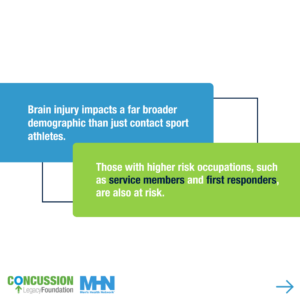
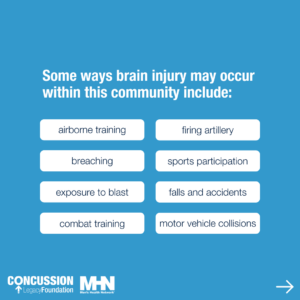
While we often see and hear stories of former contact and collision athletes struggling with the effects of single and repeated brain injuries, we know that brain injury affects a much wider demographic, including children on the playground, accident survivors and those at higher risk occupations, such as our service members and first responders. Some ways in which brain injury can occur in this community include airborne training, hacking, blast exposure, combat training, artillery fire, sports participation, falls and accidents, and motor vehicle collisions.
According to the DOD Traumatic Brain Injury Center of Excellence, more than 485,000 service members have suffered a traumatic brain injury since 2000.[1]
We also know that brain injuries are vastly underreported, so it is likely that there are many more service members who have suffered a brain injury while on duty and many more who have suffered a brain injury off duty in their daily lives. We also know that our first responders are at risk of brain damage. A recent study of first responders found that an alarming 74% of police officers studied reported a history of at least one brain injury, with 30% reporting at least one injury on the job.[2]
This study also noted that many of these injuries went unreported and untreated.
Without a doctor’s help and proper treatment after a brain injury, the possibility of prolonged symptoms and difficulties increases. This is why recognizing and reporting brain injuries is of utmost importance.
If you or a loved one suffers a concussion, here are some signs and symptoms to be aware of:
Signs of a concussion include;:
- Problems with balance
- Glazed look in the eyes
- Amnesia
- Delayed response to questions
- Forgetting an instruction, getting confused about an assignment or position, or getting confused about the game, the score, or the opponent
- Inappropriate crying
- Inappropriate laughter
- Vomiting
- Loss of consciousness
Common GImpact symptoms:
Physical (Physical) Symptoms
- Headache
- faint
- Dizziness
- Nausea
- Sensitivity to light
- Sensitivity to noise
Cognitive symptoms
- Difficulty paying attention
- Memory problems
- Loss of focus
- Difficulty multitasking
- Difficulty completing mental tasks
Sleep symptoms
- He sleeps more than usual
- Sleep less than usual
- You have trouble sleeping
Emotional symptoms
- Worry
- Depression
- Panic attacks
As we continue to learn more about how concussions affect this community, one area of research that has gained more attention recently is the relationship between brain injuries and mental health outcomes.
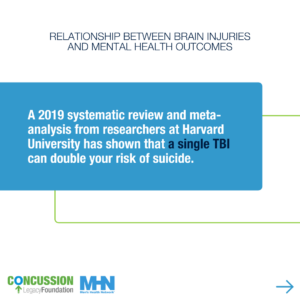
A 2019 systematic review and meta-analysis by researchers at Harvard University found that a single traumatic brain injury can double the risk of suicide.[3]
And this isn’t the only study that has linked negative mental health outcomes to brain damage. A 2022 study from the Children’s Hospital of Eastern Ontario (CHEO) found that children diagnosed with a concussion were 40% more likely to develop a new mental health disorder after their injury than children diagnosed with an orthopedic injury.[4]
But does this also apply to our service members and first responders?
The answer is yes.
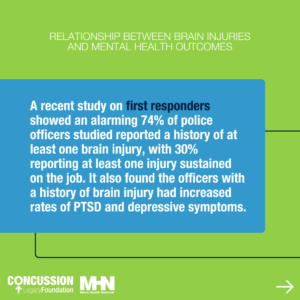
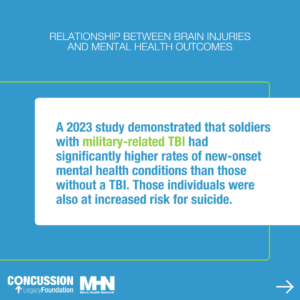
A 2023 study looked at the records of more than 860,000 US military service members and found that soldiers with military traumatic brain injury had significantly higher rates of new-onset mental health conditions than those without TBI. These individuals were also at increased risk of suicide.[5] In addition, the study that found 74% of police officers reported a history of brain injury also found that officers with a history of brain injury had increased rates of PTSD and depressive symptoms than those who did not report a history of brain injury.2
If you are reading this and struggling with the effects of brain injury, we are here for you.
Whether your injury was recent or years ago, if you’re still experiencing symptoms and don’t know where to turn, the Concussion Legacy Foundation can help.
Us CLF Helpline and Peer support The programs offer opportunities to get the help you need from a trusted team.
Whether you need help finding medical providers in your area, or are simply looking for someone to talk to who understands your situation, we encourage you to contact us at CLFHelpLine.org.
About Samantha Bureau, PhD
Dr. Samantha Bureau is a Canadian neuroscientist specializing in neurodegenerative diseases, best known for her work investigating brain damage and chronic traumatic encephalopathy. During her doctoral training, she specialized in the cellular and molecular medicine of Parkinson’s and Alzheimer’s disease, exploring therapeutic targets to alter disease progression. Dr. Bureau has had the privilege of training military personnel in NATO exercises and involving senior officials from the Canadian Armed Forces, the Brain Injury in Sport Task Force in the United Kingdom and the Federal-Provincial-Territorial Task Force on Sport in Canada. In particular, her work has inspired change around the world, influencing the NIH, NHS, PFA, AFL and the Australian Senate Committee, among others, to update their views on the causation of CTE.
Prior to joining the Concussion Legacy Foundation, Dr. Bureau has worked at leading academic research institutions such as Boston University’s CTE Center and the University of Ottawa’s Institute for Brain and Mind Research. She currently serves as Director of International Programs at CLF, where she oversees the institution’s patient service programs, international operations, and ongoing global research initiatives and collaborations.
Dr. Bureau is a former NCAA dual-sport athlete in ice hockey and track and field. She received her PhD in Neuroscience from Carleton University and her MBA from Cornell University and Queen’s University.
References:
[1] DOD Traumatic Brain Injury Center of Excellence.
[2] Caccese JB, Smith CR, Edwards NA, et al. Silent Struggles: Traumatic Brain Injuries and Mental Health in Law Enforcement. J Head Trauma Rehabil. Published online August 5, 2024. doi:10.1097/HTR.00000000000000986
[3] Fralick M, Sy E, Hassan A, Burke MJ, Mostofsky E, Karsies T. Association of Concussion With the Risk of Suicide: A Systematic Review and Meta-analysis. JAMA Neurol. 2019? 76 (2): 144-151. doi:10.1001/jamaneurol.2018.3487
[4] Ledoux AA, Webster RJ, Clarke AE, et al. Risk of mental health problems in children and adolescents after concussion. JAMA Network Open. 2022;5(3):e221235. Published March 1, 2022. doi:10.1001/jamanetworkopen.2022.1235
[5] Brenner LA, Forster JE, Gradus JL, et al. Associations of Military-Related Traumatic Brain Injury with Emerging Mental Health Conditions and Suicide Risk. JAMA Network Open. 2023? 6(7): e2326296. Posted 2023 July 3. doi:10.1001/jamanetworkopen.2023.26296
