


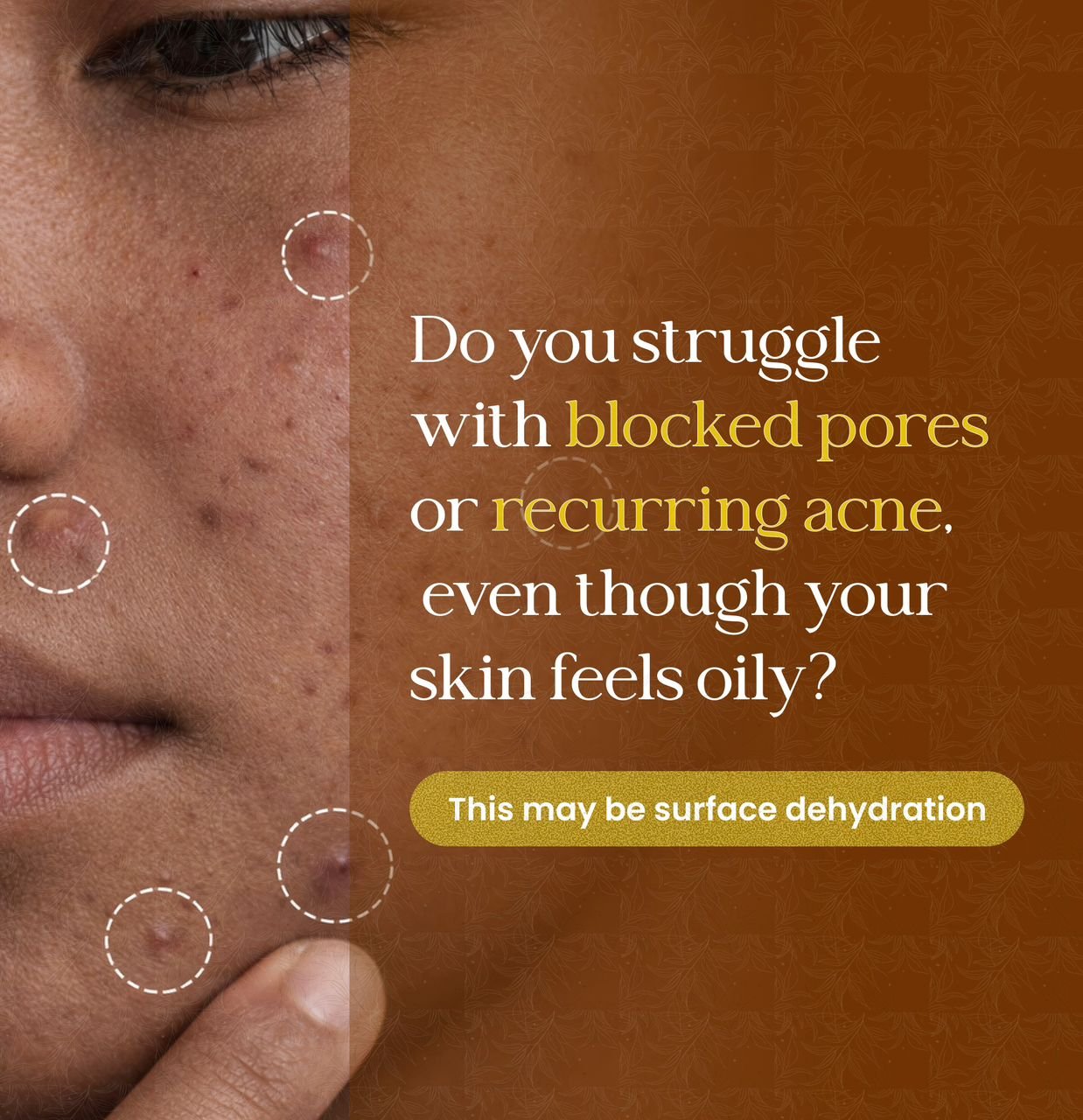
After 7 years of clinical research in tropical environmentsRecognized XCAPE by Edith Delight four key skin concerns that consistently affect melanin-rich skin regardless of age, location or lifestyle.
These four concerns are:
Surface dehydration
Hyperpigmentation
Weak elasticity
Hyperactive sebaceous activity
These findings now constitute the scientific basis behind every XCAPE formulation.
While all four concerns play a critical role in skin health, surface dehydration emerged as the most overlooked trigger, it often silently leads to many other skin problems.
In this article, we take a deeper look what superficial dehydration really is, why it affects melanin-rich skin differently, and how restoring hydration is essential for healthy, balanced skin.
What is surface dehydration?
Surface dehydration is one of the most misunderstood skin conditionsespecially in melanin-rich skin.
Unlike dryness, dehydration has nothing to do with the oil level.
Surface dehydration simply means Your skin is dehydrated.
This is why the skin may feel:
Oily
Shiny
Crowding
Acne prone
and still be severely dehydrated below.
This confusion often leads people to avoid moisturizing or overload their skin with heavy products, both of which exacerbate the imbalance.
Why surface dehydration occurs in all seasons (but worsens in winter)
Your skin is constantly exposed to environmental stressors that affect its ability to retain water, such as:
These stressors gradually weaken the skin barrier, allowing water to escape faster than it can be replaced.
During winter, this imbalance accelerates because:
Cold air holds very little moisture
Indoor heating further dries the air
A hot shower removes protective lipids
Low temperatures reduce the fluidity of natural oil
This combination creates ideal conditions for rapid water lossespecially in skin rich in melanin, which naturally has a more reactive barrier function.
How does surface dehydration actually begin?
Healthy skin maintains hydration through a strong outer barrier consisting of:
This barrier regulates:
When this barrier is compromised, water escapes faster than it can be replaced – a process known as transepidermal water loss (TEWL).
Over time, the skin enters a chronic state of dehydration.
Common triggers include:
Climate and seasonal changes
Cold, dry air
Over-cleaning
Skin care products with a high amount of alcohol
Excessive exfoliation
exposure to UV radiation
Long-term barrier neglect
Winter does not cause dehydration. the reveals pre-existing weaknesses in the skin barrier.
Because dehydrated skin produces more oil
When the skin senses water loss, it activates a survival response.
To protect itself, it increases oil production (sebum) in an attempt to seal the surface. However, the oil it cannot replace water.
This leads to a vicious circle:
Skin feels oily but firm
It looks shiny but feels uncomfortable
It gets congested but lacks shine
In melanin-rich skin, this often appears as:
Persistent or recurring breakouts
Blocked resources
Ash or gray undertones
Rough or uneven texture
Makeup that doesn’t sit right
Fine lines appear earlier than expected
These are not just aesthetic issues. They are signs of a water-deficient skin barrier.

Because superficial dehydration worsens other skin concerns
Through clinical observation, XCAPE identified superficial dehydration as a trigger core behind many secondary skin concerns.
When dehydration persists:
This explains why superficial dehydration often worsens:
Hyperpigmentation
Acne and congestion
Premature aging
Loss of skin firmness
Hydration isn’t just about glow. it is fundamental to skin health, tone, texture and longevity.
Because heavy creams do not correct dehydration
A common response to winter dryness is to layer on thick creams or oils.
While these can slow water loss temporarily, they don’t teach the skin how to do it they retain water.
Actual hydration depends on:
Reset barrier mode
Supply of hygroscopics that bind water
Reducing inflammation
Supporting skin consistently, not reactively
Hydration should be felt light, efficient and smart — not heavy or suffocating.
The XCAPE Clinical Approach to Surface Hydration
After years of clinical research, XCAPE developed a hydration system designed specifically for Skin physiology rich in melanin.
To effectively treat superficial dehydration, we recommend combining:
XCAPE Treatment Glycerin
A powerful moisturizer that attracts water to the skin and rebuilds hydration reserves without clogging pores or causing breakouts.
XCAPE Hydrating Serum
Designed to strengthen barrier function, improve water retention, soothe inflammation and restore comfort and elasticity.
Used together, these:
Increase the water content of the skin
Stabilization of oil production
Improve texture and shine
Strengthen the durability of the barrier
Reduce sensitivity and congestion
This approach restores hydration without gravityrespecting the unique structure and needs of melanin-rich skin.

