

Close Menu
Healthtost
  • News
  • Mental Health
  • Men’s Health
  • Women’s Health
  • Skin Care
  • Sexual Health
  • Pregnancy
  • Nutrition
  • Fitness
  • Recommended Essentials
What's Hot

Penn State study links family structure to lower ADHD symptoms

March 3, 2026

How to find the right deodorant for smelly armpits

March 3, 2026

How to protect face from Holi colors safely

March 3, 2026
Facebook X (Twitter) Instagram
  • About Us
  • Contact Us
  • Privacy Policy
  • Terms and Conditions
  • Disclaimer
Facebook X (Twitter) Instagram
Healthtost
SUBSCRIBE
  • News

    Penn State study links family structure to lower ADHD symptoms

    March 3, 2026

    Scientists have proposed a new theory of brain development

    March 2, 2026

    Prediction of disease intensity through genomic risk

    March 2, 2026

    Continued NIH investment fuels TMJ pain research

    March 1, 2026

    NIH Grants Evaluation of Expanded Medicare Advantage Benefits

    March 1, 2026
  • Mental Health

    Is It Sadness or Depression? Understand it…

    March 1, 2026

    Teen anxiety linked to sugary drinks – new research

    February 28, 2026

    Self-Care Guided Journal For Moms

    February 26, 2026

    Forgiveness isn’t always easy, but studies show it can help you flourish

    February 24, 2026

    50 Inspirational Ways to Navigate Your Life by Susie Hall

    February 22, 2026
  • Men’s Health

    How to find the right deodorant for smelly armpits

    March 3, 2026

    The Case for Weightlifting Shoes

    March 2, 2026

    The Secret to Saving Humanity: What We Must Do Now

    March 2, 2026

    40 Minute Lower Body Workout: A leg muscle building session

    February 26, 2026

    Colonoscopy and FIT at age 60 catch colon cancer earlier

    February 24, 2026
  • Women’s Health

    How to protect face from Holi colors safely

    March 3, 2026

    Jocelyn Elders: A Legacy Better Than the Title

    March 1, 2026

    10 Ways to Calm Your Cortisol and Get Your Energy Back as a Busy Woman

    February 27, 2026

    Is trauma therapy right for you? Signs that you may benefit from specialized care

    February 27, 2026

    The connection between mental health and heart health

    February 25, 2026
  • Skin Care

    6 Marketing Myths About Caffeine’s Skin Benefits

    March 3, 2026

    Polydioxanone (PDO) Histological Analysis Threads: Differentiating neocollagenesis from the fibrous foreign body response

    February 28, 2026

    The Pharmacist’s Guide to Reversing Cellular

    February 26, 2026

    Sudoku skin care device ⭐️

    February 26, 2026

    Exosome Facelift Facial in NYC: The Advanced Skin Renewal Treatment at

    February 24, 2026
  • Sexual Health

    The discussion of the Epstein files is mistaken for pedophilia and power

    March 2, 2026

    Survival strategies and health effects in forced displacement

    March 1, 2026

    How Intense Competition and Intimacy Tuning Are Elevating Modern TV Romance — Alliance for Sexual Health

    February 28, 2026

    New type of Mpox diagnosed in England

    February 25, 2026

    Jesse Jackson opened the doors for black women in politics

    February 22, 2026
  • Pregnancy

    Endy Mattress Review: An Honest Look After 4 Months

    March 1, 2026

    Does bed rest prevent premature labor? New research says no

    March 1, 2026

    Is cervical cancer curable if caught early? Know the Facts

    February 27, 2026

    Management of abdominal problems during pregnancy

    February 26, 2026

    10 Ways Second Trimester Moms Can Easily Prepare Your Home

    February 25, 2026
  • Nutrition

    How the microbiome drives symptoms

    March 2, 2026

    Because cutting back on sugar actually makes you crave it more

    March 1, 2026

    5-ingredient skillet dinner recipe

    February 26, 2026

    Slow Cooker Gochujang Chicken Sandwich (Mild and Family Friendly)

    February 26, 2026

    Purified vs. Reconstructed Water – Which is Better?

    February 25, 2026
  • Fitness

    200: Autoimmune Healing, Nervous System Safety, and the Biggest Mistakes I Made on My Health Journey

    March 1, 2026

    10 Powerful Emotional Benefits of Weight Training

    February 28, 2026

    7 simple strength exercises that protect your back and improve balance after 40

    February 28, 2026

    Inside the OPEX Method Week 5: Anaerobic training, “pain” and when it really makes sense

    February 26, 2026

    Exercise, prevention and modern therapy for healthy circulation

    February 26, 2026
  • Recommended Essentials
Healthtost
Home»News»The impressive diagnostic skills of GPT-4 were demonstrated
News

The impressive diagnostic skills of GPT-4 were demonstrated

healthtostBy healthtostApril 21, 2024No Comments5 Mins Read
Facebook Twitter Pinterest LinkedIn Tumblr Reddit WhatsApp Email
The Impressive Diagnostic Skills Of Gpt 4 Were Demonstrated
Share
Facebook Twitter LinkedIn Pinterest WhatsApp Email

In a recent study published in the journal PLOS Digital Healthresearchers assessed and compared the clinical knowledge and diagnostic reasoning capabilities of large language models (LLMs) with those of human ophthalmology experts.

Study: Large language models approximate expert-level clinical knowledge and reasoning in ophthalmology: A cross-sectional study. Image credit: ozrimoz / Shutterstock

Record

Generative Pre-trained Transformers (GPTs), GPT-3.5 and GPT-4, are advanced language models trained on massive Internet-based datasets. They power ChatGPT, a conversational artificial intelligence (AI) noted for its medical application success. Despite previous models struggling in specialized medical tests, the GPT-4 shows significant advances. Concerns remain about data “contamination” and the clinical relevance of test scores. Further research is needed to validate the clinical applicability and safety of language models in real medical settings and to address existing limitations in their expert knowledge and reasoning abilities.

About the study

The questions for the Part 2 examination of the Fellowship of the Royal College of Ophthalmologists (FRCOphth) have been extracted from a specialist manual that is not widely available online, minimizing the likelihood of these questions appearing in LLM training data. A total of 360 multiple-choice questions spanning six chapters were extracted and a pool of 90 questions was isolated for a mock examination used to compare the performance of LLMs and MDs. Two researchers aligned these questions with the categories established by the Royal College of Ophthalmologists and classified each question according to Bloom’s levels of cognitive processes. Questions with non-text elements that were unsuitable for LLM entry were excluded.

Exam questions were entered into versions of ChatGPT (GPT-3.5 and GPT-4) to collect responses, repeating the process up to three times per question where necessary. Once other models such as Bard and HuggingChat became available, similar tests were conducted. Correct answers, as defined by the textbook, were noted for comparison.

Five specialist ophthalmologists, three intern ophthalmologists and two general practitioners independently completed the virtual examination to assess the practical application of the models. Their answers were then compared with the answers of the LLMs. After testing, these ophthalmologists rated the LLMs’ responses using a Likert scale to rate accuracy and relevance, without knowing which model provided which response.

The statistical design of this study was powerful enough to detect significant performance differences between LLMs and human doctors, aiming to test the null hypothesis that both would perform similarly. Various statistical tests, including chi-squared and paired t-tests, were applied to compare performance and assess the consistency and reliability of LLM responses versus human responses.

Study results

Of the 360 ​​questions contained in the FRCOphth Part 2 exam manual, 347 were selected for use, including 87 from the mock exam chapter. The exceptions were mostly questions with pictures or tables, which were unsuitable for input into LLM interfaces.

Performance comparisons revealed that GPT-4 significantly outperformed GPT-3.5, with a correct response rate of 61.7% versus 48.41%. This advance in GPT-4 capabilities was consistent across different types of questions and subjects, as outlined by the Royal College of Ophthalmologists. Detailed results and statistical analyzes further confirmed the strong performance of GPT-4, making it a competitive tool even among other LLMs and human doctors, especially junior doctors and trainees.
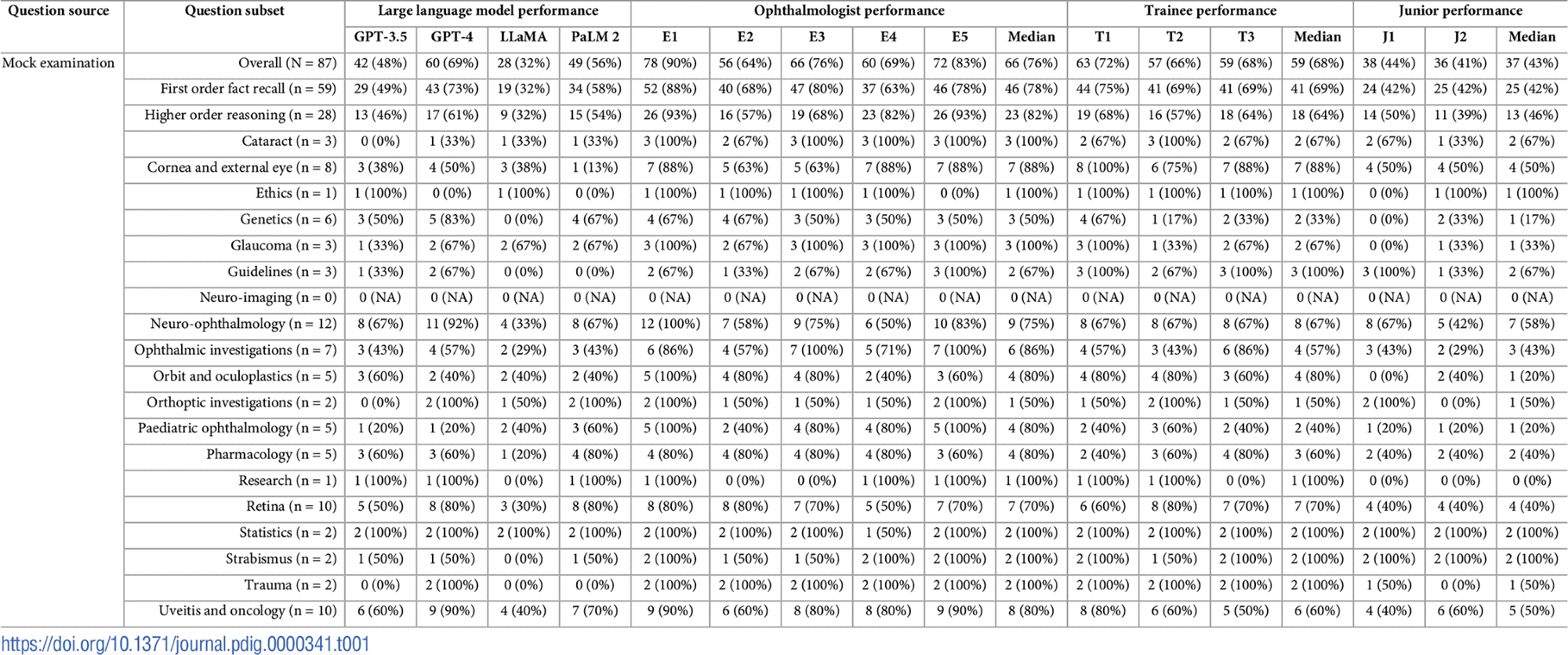
Exam features and detailed performance data.  Topic and question type distributions are presented along with the scores achieved by LLMs (GPT-3.5, GPT-4, LLaMA and PalM 2), Ophthalmologists (E1-E5), Ophthalmologists (T1-T3) and non-ophthalmologists (T1-T3). specialized young doctors (J1- J2).  Median scores do not necessarily add up to the overall median score, as fractional scores are impossible.Exam features and detailed performance data. Topic and question type distributions are presented along with the scores achieved by LLMs (GPT-3.5, GPT-4, LLaMA and PalM 2), Ophthalmologists (E1-E5), Ophthalmologists (T1-T3) and non-ophthalmologists (T1-T3). specialized young doctors (J1- J2). Median scores do not necessarily add up to the overall median score, as fractional scores are impossible.

In the specially adapted 87-question mock exam, the GPT-4 not only outperformed among LLMs, but also scored comparably to ophthalmologists and significantly better than juniors and interns. Performance across different groups of participants showed that while specialist ophthalmologists maintained the highest accuracy, trainees approached these levels, far outperforming junior non-ophthalmology specialists.

Statistical tests also highlighted that agreement between responses given by different LLMs and human participants was generally low to moderate, indicating variation in reasoning and application of knowledge between groups. This was particularly evident when the differences in knowledge between the models and human doctors were compared.

A detailed examination of the mock questions against the actual exam standards showed that the mock setup closely mirrored the actual FRCOphth Part 2 Written Exam in difficulty and structure, as agreed upon by the ophthalmologists involved. This alignment ensured that the assessment of LLMs and human responses was based on a realistic and clinically relevant framework.

In addition, qualitative feedback from ophthalmologists confirmed a strong preference for GPT-4 over GPT-3.5, correlating with quantitative performance data. The higher accuracy and relevance scores for the GPT-4 highlighted its potential utility in clinical settings, particularly in ophthalmology.

Finally, an analysis of the cases where all LLMs failed to provide the correct answer showed no consistent patterns related to the complexity or subject matter of the questions.

demonstrated diagnostic GPT4 impressive skills
bhanuprakash.cg
healthtost
  • Website

Related Posts

Penn State study links family structure to lower ADHD symptoms

March 3, 2026

Scientists have proposed a new theory of brain development

March 2, 2026

Prediction of disease intensity through genomic risk

March 2, 2026

Leave A Reply Cancel Reply

Don't Miss
News

Penn State study links family structure to lower ADHD symptoms

By healthtostMarch 3, 20260

Starting primary school is an important milestone, but it can be a difficult transition as…

How to find the right deodorant for smelly armpits

March 3, 2026

How to protect face from Holi colors safely

March 3, 2026

6 Marketing Myths About Caffeine’s Skin Benefits

March 3, 2026
Stay In Touch
  • Facebook
  • Twitter
  • Pinterest
  • Instagram
  • YouTube
  • Vimeo
TAGS
Baby benefits body brain cancer care Day Diet disease exercise finds Fitness food Guide health healthy heart Improve Life Loss Men mental Natural Nutrition Patients People Pregnancy protein research reveals risk routine sex sexual Skin study Therapy Tips Top Training Treatment ways weight women Workout
About Us
About Us

Welcome to HealthTost, your trusted source for breaking health news, expert insights, and wellness inspiration. At HealthTost, we are committed to delivering accurate, timely, and empowering information to help you make informed decisions about your health and well-being.

Latest Articles

Penn State study links family structure to lower ADHD symptoms

March 3, 2026

How to find the right deodorant for smelly armpits

March 3, 2026

How to protect face from Holi colors safely

March 3, 2026
New Comments
    Facebook X (Twitter) Instagram Pinterest
    • About Us
    • Contact Us
    • Privacy Policy
    • Terms and Conditions
    • Disclaimer
    © 2026 HealthTost. All Rights Reserved.

    Type above and press Enter to search. Press Esc to cancel.