

Close Menu
Healthtost
  • News
  • Mental Health
  • Men’s Health
  • Women’s Health
  • Skin Care
  • Sexual Health
  • Pregnancy
  • Nutrition
  • Fitness
  • Recommended Essentials
What's Hot

A cancer-causing contaminant in drugs and meat

May 3, 2026

Landmine Training and Why I Love It – Tony Gentilcore

May 3, 2026

Five-target drug beats GLP-1/GIP therapy in obese diabetic mice

May 3, 2026
Facebook X (Twitter) Instagram
  • About Us
  • Contact Us
  • Privacy Policy
  • Terms and Conditions
  • Disclaimer
Facebook X (Twitter) Instagram
Healthtost
SUBSCRIBE
  • News

    Five-target drug beats GLP-1/GIP therapy in obese diabetic mice

    May 3, 2026

    How fast your face ages can predict cancer survival outcomes

    May 2, 2026

    AI scribes save doctors time, but fail to reduce overtime

    May 2, 2026

    Identifying the ages at which Alzheimer’s biomarkers change sharply

    May 1, 2026

    Timing of food may shape how T cells respond to infection and therapy

    May 1, 2026
  • Mental Health

    Every mental health journey starts with being seen

    May 2, 2026

    What animal studies teach us about toxic work environments

    April 27, 2026

    I hate hope: How to manage hope when you have treatment-resistant bipolar disorder

    April 19, 2026

    Rose Byrne is raw, magnetic and unfiltered as a woman in crisis

    April 18, 2026

    Can a single mother change her child’s surname in India?

    April 16, 2026
  • Men’s Health

    3 Day Home Workout Plan: Build Muscle and Burn Fat

    April 30, 2026

    GLP-1 drugs promise broader health benefits, but experts advise caution on use

    April 28, 2026

    Trauma patients recover faster when medical teams know each other well, new study finds

    April 28, 2026

    I did red light therapy for 3 months so I shouldn’t have

    April 27, 2026

    Sex Secrets for Men Over 40: Surviving Male Menopause

    April 27, 2026
  • Women’s Health

    What is the difference between UVA and UVB rays?

    May 1, 2026

    Are you a fungus fanatic? We unpack the nutritional trend of mushroom mania

    April 29, 2026

    What the Patients’ Bill of Rights Could Mean for Black Women

    April 29, 2026

    Navigating sexual health during and after cancer

    April 28, 2026

    Do tampons break the hymen? Facts, Myths and What You Need to Know – Vuvatech

    April 27, 2026
  • Skin Care

    The truth about waterless care: What your skin really needs

    May 2, 2026

    What happens to your skin while you sleep? (the science of “Beauty Sle

    May 1, 2026

    Face Peeling Mask Guide: Shine Without Irritation

    April 28, 2026

    Is your moisturizing face mist really drying out your skin?

    April 28, 2026

    Uses and Benefits of TNW Natural Aloe Vera Face Gel – The Natural Wash

    April 27, 2026
  • Sexual Health

    Boost erectile health and confidence

    May 1, 2026

    Judicial Restrictions on Abortion COVID-19 < SRHM

    April 30, 2026

    Can herpes affect fertility?

    April 29, 2026

    The Importance of Personalized Care in Medication Assisted Therapy (MAT) Programs I Novus

    April 28, 2026

    Your favorite mold is lying to you (a little) — Sexual Health Alliance

    April 28, 2026
  • Pregnancy

    Why is anemia during pregnancy high in Indian women?

    May 2, 2026

    5 things you need for the third trimester

    May 1, 2026

    Eating disorders in pregnancy and breastfeeding: Why “healthy eating” is not always easy

    May 1, 2026

    Comprehensive yoga for pregnancy, birth and beyond

    April 29, 2026

    Midwifery and Life – The postnatal health check New mums don’t know they can ask for

    April 28, 2026
  • Nutrition

    A cancer-causing contaminant in drugs and meat

    May 3, 2026

    How Nutrition Supports Mood, Energy and Gut Health

    May 2, 2026

    How to create a self-care plan when you’re stressed

    May 1, 2026

    I answer the most HOT Questions about Fatty Liver

    April 29, 2026

    Why You’re Not Losing Weight After 35 (Even When You Eat Less)

    April 28, 2026
  • Fitness

    Landmine Training and Why I Love It – Tony Gentilcore

    May 3, 2026

    9 Powerful Fitness Tips for Pear Shaped Bodies

    May 2, 2026

    If you can still do these 7 things at 60, your body is aging better than most

    May 2, 2026

    A Hike Leader’s Must-Have Kit

    April 30, 2026

    Menopausal Hair Loss Solutions: 10 Expert Tips

    April 29, 2026
  • Recommended Essentials
Healthtost
Home»Mental Health»Using games to explore the mind
Mental Health

Using games to explore the mind

healthtostBy healthtostJanuary 10, 2024No Comments6 Mins Read
Facebook Twitter Pinterest LinkedIn Tumblr Reddit WhatsApp Email
Using Games To Explore The Mind
Share
Facebook Twitter LinkedIn Pinterest WhatsApp Email

January 9, 2024
• Institute update

The National Institute of Mental Health (NIMH) and the non-profit organization The Many Brains Project cooperated with National Institutes of Health (NIH) all of us Research program to customize a number of new game-like tasks that are now part of it all of us Experience participating in the Research Program. Quizzes, puzzles and other engaging exercises measure abilities such as attention span, decision making and emotion recognition.

The all of us Research program

The all of us The Research Program is a large-scale NIH-led effort to collect and study data from at least one million people in the United States. People participating in the program are asked to fill out surveys on different topics, share data from their electronic health records, complete online tasks and provide biological samples (such as saliva).

Why NIMH partnered with all of us?

In 2009, NIMH developed the Research Domain Criteria Initiative, known as RDoC. RDoC was created as a new way of conceptualizing and studying mental disorders. In this context, mental disorders are studied through the lens of different functional processes, such as cognition, mood, social interactions, etc., with characteristics that exist on a continuum ranging from typical to extreme.

NIMH is interested in collecting data on some of the factors that are part of the RDoC framework, such as cognitive, social, and reward processes, from a large, diverse group of participants—exactly the type of participant cohort created through all of us. As a bonus, all of us collects many other mental and physical health data. When combined with information gleaned from the new gamified tasks, this data could help researchers understand what leads to mental disorders, how they develop and the most effective ways to treat them.

Courtesy of the NIH/All of Us Research Program.

In 2016, RDoC staff convened a task force to identify behavioral tests that could measure factors in the RDoC context. After reviewing the list of tests, RDoC staff selected several with strong normative data — baseline scores or metrics against which the new scores can be compared. RDoC staff then issued multi-year contracts to different teams, asking them to turn the tests into easy-to-use gamified tasks that were still valid for measuring the intended concepts.

Four tasks—Guess the Emotion, Left or Right, City or Mountain, and Now or Later—were eventually adapted to be part of all of us Research program. These four jobs were created as part of the non-profit organization TestMyBrain Platform with support from The Many Brains Project.

What are the new tasks and what do they measure?

NIMH partnered with All from U.S to introduce four different tasks to their platform: Guess the Emotion, Left or Right, City or Mountain and Now or Later.

  • Guess the feeling: The Guess the Emotion task asks participants to look at pictures of people and name people’s emotions based on their facial expressions. This task is a version of the Face Emotion Identification task, which is used to learn about social processes, social communication, and how people receive information conveyed through facial expressions.
  • Left or right: The task Left or Right measures how well people can focus in distracting environments. The task starts with a screen showing five arrows—a central arrow between two sets of side arrows. The five arrows change direction during the task, and the participant must indicate the direction of only the middle arrow. This can be difficult because the side arrows can point in a different direction than the middle arrow. This task is a version of the Flanker task, which measures attention and response inhibition, or the ability to stop a response elicited by inappropriate information (in this case, the flanker arrows).
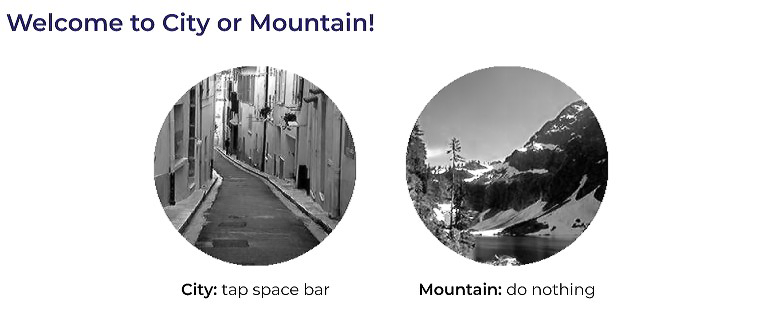
An image of the project City vs.  Mountain showing an image of a city street with directions saying to "Press the space bar" and a picture of a mountain with instructions saying yes "Don't do anything."

Courtesy of the NIH/All of Us Research Program.
  • City or Mountain: The City or Mountain task tests how quickly participants respond—or how well participants resist responding—to a changing scene. During work, city or mountain scenes fade in and out. Participants are asked to press a response key only when they see a picture of a city. This task is a type of gradual start continuous performance task. It is used to understand cognitive systems such as attention, cognitive control, and the ability to respond to only one type of information while ignoring others.
  • Now or later: In the Now or Later task, participants are presented with different pretend scenarios where they are offered a certain amount of money after certain waiting times. The amount of money and the waiting time change in each scenario. In essence, participants decide whether they would like a smaller monetary reward over a short period of time or a larger monetary reward over a longer period of time. This is a delay discounting task, which measures a person’s individual level of temporal discounting, or how long they are willing to wait for a specific reward. This information helps researchers understand how people evaluate the value of rewards.

All of these tasks measure aspects of behavior that may vary from person to person. For example, some people may be quick to recognize emotion in a face, while others may be slower. Some people may feel better when they receive a larger reward, even if they have to wait, while others may see the more immediate reward as more valuable. Mental disorders can affect these behaviors in different ways. Understanding how these behaviors change with mental health offers insights into how mental disorders affect the brain. It could also inform interventions or treatments so that they have the greatest benefit for patients.

How will information from these tasks be used?

All data collected as part of all of us The Research Program, including information collected using these new tasks, will be available in the future for analysis by researchers. Its sheer size all of us The dataset and many types of information collected through the program—genetic, physical, mental health, etc.—allow researchers to make new connections between these health factors and expand our understanding of how they work together in health and the disease. Researchers can visit ResearchAllofUs.org to learn more or register to use it all of us data set.

Participation in all of us is free and open to anyone 18 and over. People can learn more about joining at all of us Research Program in JoinAllofUs.org .

Explore games mind
bhanuprakash.cg
healthtost
  • Website

Related Posts

Every mental health journey starts with being seen

May 2, 2026

What animal studies teach us about toxic work environments

April 27, 2026

I hate hope: How to manage hope when you have treatment-resistant bipolar disorder

April 19, 2026

Leave A Reply Cancel Reply

Don't Miss
Nutrition

A cancer-causing contaminant in drugs and meat

By healthtostMay 3, 20260

Billions of dollars worth of drugs have been pulled from the market for less carcinogenic…

Landmine Training and Why I Love It – Tony Gentilcore

May 3, 2026

Five-target drug beats GLP-1/GIP therapy in obese diabetic mice

May 3, 2026

How Nutrition Supports Mood, Energy and Gut Health

May 2, 2026
Stay In Touch
  • Facebook
  • Twitter
  • Pinterest
  • Instagram
  • YouTube
  • Vimeo
TAGS
Baby benefits body brain cancer care Day Diet disease exercise finds Fitness food Guide health healthy heart Improve Life Loss Men mental Natural Nutrition Patients Pregnancy protein research reveals risk routine sex sexual Skin Skincare study Therapy Tips Top Training Treatment ways weight women Workout
About Us
About Us

Welcome to HealthTost, your trusted source for breaking health news, expert insights, and wellness inspiration. At HealthTost, we are committed to delivering accurate, timely, and empowering information to help you make informed decisions about your health and well-being.

Latest Articles

A cancer-causing contaminant in drugs and meat

May 3, 2026

Landmine Training and Why I Love It – Tony Gentilcore

May 3, 2026

Five-target drug beats GLP-1/GIP therapy in obese diabetic mice

May 3, 2026
New Comments
    Facebook X (Twitter) Instagram Pinterest
    • About Us
    • Contact Us
    • Privacy Policy
    • Terms and Conditions
    • Disclaimer
    © 2026 HealthTost. All Rights Reserved.

    Type above and press Enter to search. Press Esc to cancel.