


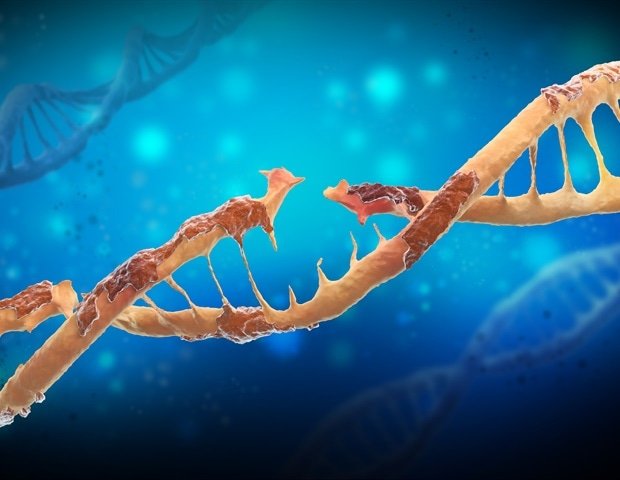
A previously unknown type of DNA damage in mitochondria, the tiny energy factories inside our cells, could shed light on how our bodies sense and respond to stress. The findings of the UC Riverside study are published today in the Proceedings of the National Academy of Sciences and have potential implications for a range of diseases associated with mitochondrial dysfunction, including cancer and diabetes.
Mitochondria have their own genetic material, known as mitochondrial DNA (mtDNA), which is essential for producing the energy that powers our bodies and sending signals in and out of cells. While it has long been known that mtDNA is prone to damage, scientists did not fully understand the biological processes involved. New research pinpoints a culprit: glutathionylated DNA adducts (GSH-DNA).
An adduct is a bulky chemical tag formed when a chemical, such as a carcinogen, attaches directly to DNA. If the damage is not repaired, it can lead to DNA mutations and increase the risk of disease.
A ‘sticky’ problem for mitochondrial DNA
The researchers found in their experiments in cultured human cells that these adducts accumulate to levels up to 80 times higher in mtDNA than in the cell’s nuclear DNA, suggesting that mtDNA is particularly vulnerable to this type of damage.
Linlin Zhao, senior author and associate professor of chemistry at UCR, explained that mtDNA makes up only a small fraction—about 1-5%—of the total DNA in a cell. It is circular in shape, has only 37 genes and is transmitted only from the mother. In contrast, nuclear DNA (nDNA) has a linear shape and is inherited from both parents.
mtDNA is more prone to damage than nDNA. Each mitochondrion has multiple copies of mtDNA, which provides some backup protection. The repair systems for mtDNA are not as strong or efficient as those for nuclear DNA.”
Linlin Zhao, senior author and associate professor of chemistry at UCR
Lead researcher and first author Yu Hsuan Chen, a doctoral student in Zhao’s lab, likened the mitochondrion to the cell’s engine and signaling hub.
“When the engine manual — the mtDNA — gets damaged, it’s not always a misspelling, a mutation,” Chen said. “Sometimes, it’s more like a sticky note that sticks to the pages, making it difficult to read and use. That’s what these GSH-DNA adducts do.”
From DNA damage to disease
The researchers linked the accumulation of sticky lesions to significant changes in mitochondrial function. They observed a decrease in proteins needed for energy production and a concomitant increase in proteins that help with the stress response and mitochondrial repair, suggesting that the cell is fighting back against the damage.
The researchers also used advanced computer simulations to model the effect of the adducts.
“We found that sticky tags can actually make mtDNA less flexible and more rigid,” Chen said. “This may be one way the cell ‘marks’ damaged DNA for disposal, preventing it from replicating and being passed on.”
The team’s findings hold promise for understanding the diseases. According to Zhao, the discovery of GSH-DNA adducts opens a new frontier for research into how damaged mtDNA can function as a stress signal.
“Mitochondrial problems and inflammation linked to damaged mtDNA have been linked to diseases such as neurodegeneration and diabetes,” he said. “When mtDNA is damaged, it can escape from the mitochondria and trigger immune and inflammatory responses. The new type of mtDNA modification we discovered could open new research directions to understand how it affects immune activity and inflammation.”
Zhao and Chen were joined in the study by researchers at UCR and The University of Texas MD Anderson Cancer Center.
The research was supported by grants from the National Institutes of Health and UCR.
Source:
Journal Reference:
