


This story originally reported by Erin Haynes of The 19thand republishing via Rewire News Grouphis collaboration with the 19th News Network.
Leah Daughtry was 6 years old when she first met the Rev. Jesse Jackson at a boycott of a local grocery store that refused to hire black workers.
Her father was a prominent civil rights activist and church leader long active in politics, and Jackson became a member of the Daughtry family home and church in Brooklyn. Later, when Daughtry was a student at Dartmouth College, Jackson introduced her to presidential politics when he recruited her to mobilize young voters in New Hampshire.
“It was incredibly empowering, incredibly heavy, but what I learned from that experience was that he trusted me,” Daughtry recalled. “He saw something in me and all of us that said, ‘I believe you can do it, and I’m going to give you the responsibility to help me win.’
Part of Jackson’s civil rights legacy, who died on February 17 at 84is the expansion of black women’s political power in the voting booth and within Democratic Party politics.
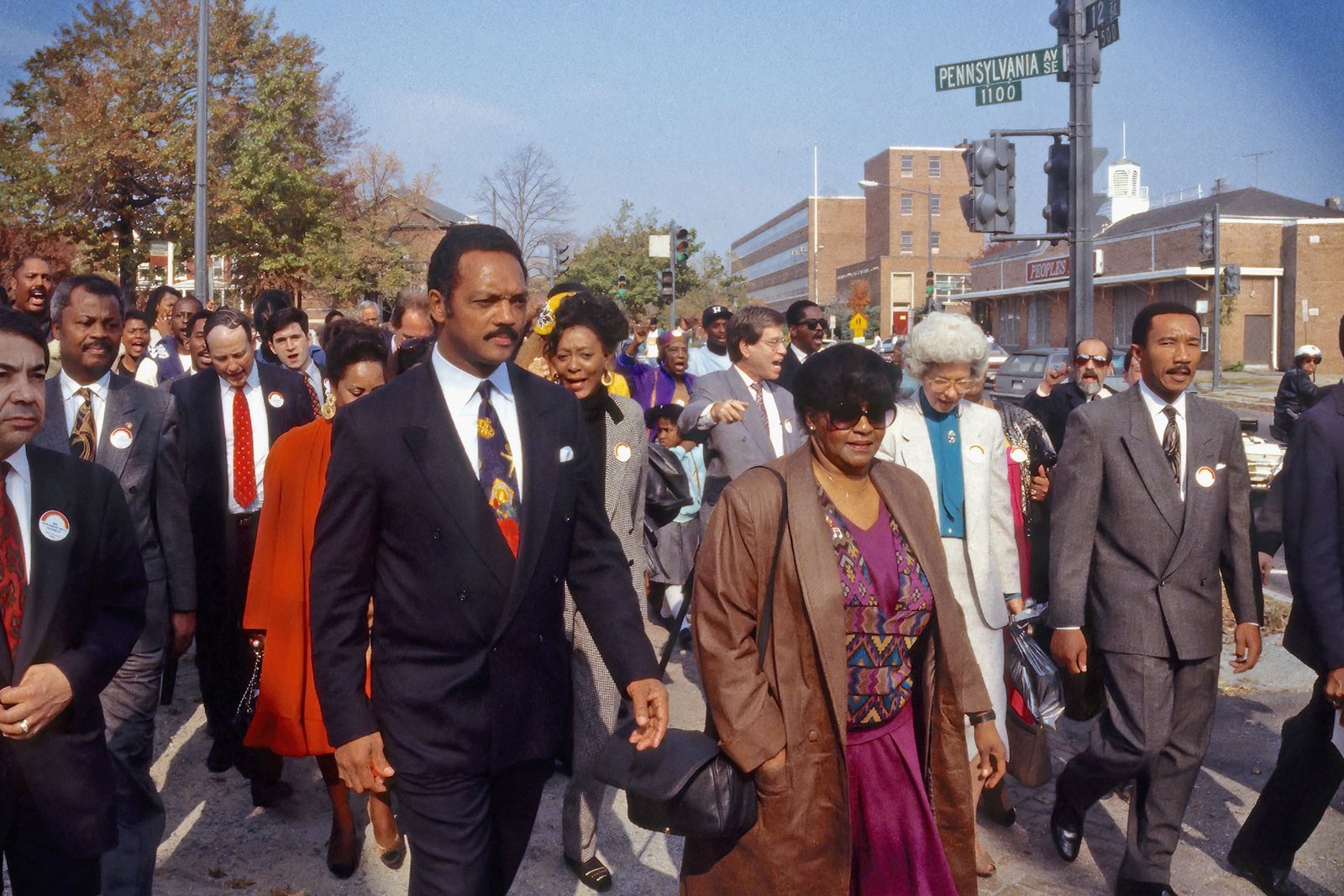
Jackson, who worked with the Rev. Martin Luther King Jr. and led key organizations in the civil rights push, including the Rainbow PUSH Coalition, also made two ultimately unsuccessful presidential runs, in 1984 and 1988. Through those votes, Jackson helped reshape these national political forces by building a national political power. leadership—including black voters, women, youth, and the working class. It was a coalition that would become the foundation of modern Democratic Party politics.
As Jackson’s civil rights work grew from movement to political power, his campaigns registered millions of new voters—what became known as the Rainbow Coalition—and diverse voter participation would become a lifelong part of the work. His campaigns helped normalize black women’s leadership beyond the ballot box as organizers, decision makers, and strategists. In the years following his presidential campaigns, black women shaped the party’s leadership and helped set the direction of American politics.
“He was saying, ‘Our patch isn’t big enough,'” Daughtry said of Jackson. “Any community, there are not enough of us to make electoral change. We need to make a quilt that has bigger patches and all together means we can get the change we all need. We are much stronger when we are together, and there are more of us – even if they don’t come from where you come from or look like you. There is common ground.”
Women were key to the Rainbow Coalition, said Melanie Campbell, who was a student at Clark College (now Clark-Atlanta University) when she volunteered with Jackson’s campaign, registering voters in Georgia.
“He had women around him politically … He let us know that we had the power to vote,” said Campbell, now president of the National Coalition for Black Civic Participation. “I didn’t know I’d end up working in civil rights. Being able to be around him and other civil rights leaders, men and women … shaped me into who I am today.”
Donna Brazile was also among the young black women who entered politics working with Jackson. In 1984, at age 23, she left a job with Coretta Scott King to work for Jackson, who used her Louisiana roots to focus on Southern voters.
She remembered him as someone who saw people as individuals, who never made her feel inferior or that she had to fight to get into rooms.
“She always included us,” said Brasilia, who would become the first black woman to manage a major-party presidential campaign in 2000. “She gave me my wings. He understood that I could organize and gave me every opportunity. It rooted me in politics. It let me know that I could manage campaigns.
Chicago native Minyon Moore was a college student working at Encyclopedia Britannica when she was hired to work at Operation PUSH, the civil rights organization founded by Jackson in her hometown. In 1988, Moore was appointed as deputy field director for Jackson’s presidential campaign.
Shirley Chisholm said, “If you don’t have a seat at the table, bring a folding chair.” The Reverend Jackson said, “You have a seat at the table—and it’s a hard chair,”—a permanent spot, Moore said. He emphasized the importance of preparation and the value of serving other people and taking on any task, no matter how big or small, he added.
Moore’s career in politics includes becoming the first black woman White House director of political affairs under President Bill Clinton, and later leading the Democratic National Committee and the party convention.
Black women elected officials are also part of Jackson’s legacy. Democratic Congresswoman Maxine Waters co-chaired Jackson’s campaigns in 1984 and 1988. She was elected to Congress in 1990 and is serving her 18th term in California’s 43rd District.
In a tribute to Jackson, former Vice President Kamala Harris wrote, “He let us know that our voices mattered. He instilled in us that we were somebody. And he paved the way for generations to follow in his footsteps and lead.”
In 1984, Jackson was only the second Black American to run for president as a major political party candidate, following Shirley Chisholm’s groundbreaking campaign in 1972. While neither was elected, voters made significant gains in political representation through Jackson’s candidacy. He pushed the Democratic Party to change its rules on rewarding delegates to end winner-takes-all primaries, creating fairer, proportional representation.
At the 2024 Democratic National Convention, where Harris accepted the party’s nomination for president, Jackson appeared on opening night to thunderous applause from the arena, a testament to his contribution to American politics. It was a full-circle moment for Moore, who said Jackson never stopped guiding her through the decades.
“He trusted us to go out and work on behalf of the people,” Moore said. “He always wanted me to know exactly what our white colleagues knew. He felt the only way to do that was to give us the experience to do it. There was never a place where we weren’t welcome.”
By inviting black women into national politics, Jackson helped ensure that they would help shape its future. His approach has lessons for the black women organizers and political strategists who promote his work, said Glynda Carr, president of Higher Heights for America.
“His two campaigns were built on this concept of a coalition, to raise the voices of the working poor, the working class, the middle class and insisting that black voters and our communities were focused on a national conversation,” said Carr, whose political action committee mobilizes black women voters to elect black women to office. “If we’re actually going to rebuild America, what does real coalition building look like?”
