


Many exercise tips for people over 50 can be summed up in two words: “Just work out.” And while exercise is certainly better than nothing (and it’s better to be fit than just active), this advice ignores something extremely important: The details of how you exercise make a huge difference in the results you get.
Exercise Recipe
When a doctor prescribes a medicine, there is a lot of precision behind it:
- Drug name
- Dosage
- With food or without food
- Morning or evening
Well, exercise is also medicine (in a very real sense, since it changes certain health indicators on par with, and in some cases, better than the best drugs out there), but like any drug, dosage determines if it works.
Somehow, when the exercise is prescribed, it changes from the same level of precision to a simple yes/no. Yes, you exercise or you don’t, you don’t. However, many key details that make the difference between effective exercise and ineffective exercise are missing. When it comes to strength training, the details you need to know to make it effective for any goal are:
- Frequency: number of days per week
- Intensity: how much weight to lift/how much resistance to use
- Volume: number of sets and repetitions
- Structure: full body or body part splits workouts
- Choice of exercise
For cardio, you need these details:
- Frequency
- Intensity: intensity is measured by your pulse.
- Duration
- Steady cardio or intervals
- If you do intervals, you should also know:
- The number of intervals
- The duration of each interval
- The rest period between intervals
Why is it important to know and follow these details? Because you want to:
- Maximum efficiency
- The best use of your time
Exercising the right way doesn’t take any more time than doing it the wrong way, but it makes all the difference in terms of effectiveness.
Case in point:
Diabetes
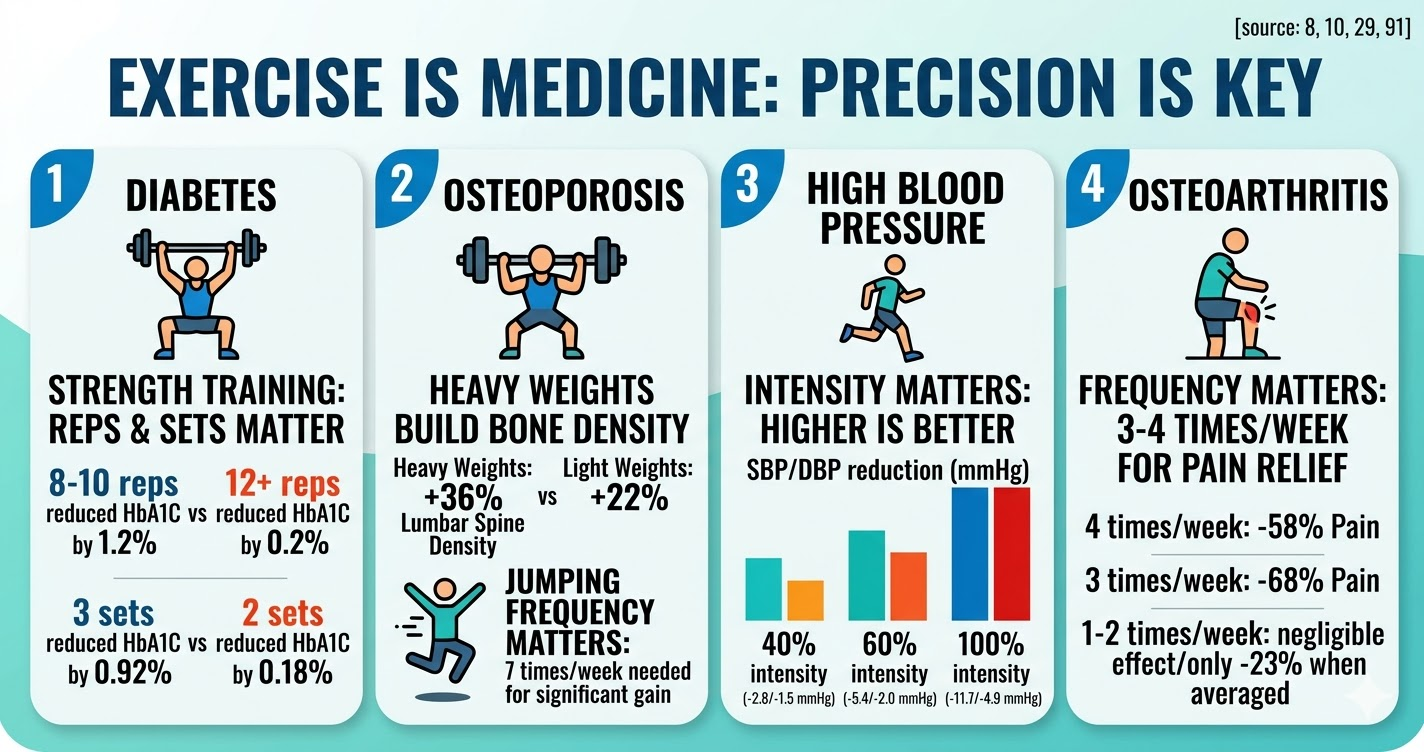
In my diabetes bookI prescribe 8-10 repetitions. This is because inside the study where people did 8-10 repetitions, HbA1C dropped by 1.2%, with no other change (for a non-diabetic, that doesn’t seem like much, so for reference, a diabetic’s A1C is at least 6.5%. So a 1.2% drop is huge). Yet, another meta-analysis showed that when you start using weights light enough that you can do more than 12 repetitions, HbA1C only drops by about 0.2%. Even if you put a lot of effort into it and get tired at the end.
Rep range also answers the question of weight selection. It’s not like picking up a light weight that you can do 20 times and stop at 10. That wouldn’t work. If you do 8-10 reps, the weight should be heavy enough that you can lift it 9-12 times.
In other words, the difference between 8 reps and 15 reps can mean the difference between significant metabolic improvement and almost no change.
There is another big difference between the number of sets. In a meta-analysis, in diabetics who did only 2 sets per exercise, their HbA1C dropped by only 0.18%. In diabetics who did 3 sets per exercise, their HbA1C decreased by 0.92%. A little more work for five times better results.
So when I talk to diabetic clients and they say they’re strength training, I have to ask a lot of follow-up questions to see if they’re strength training effectively or ineffectively. You can see that the difference between doing it right and doing it wrong makes a huge difference in the bottom line.
This is just an example of strength training – but so is cardiovascular exercise when it comes to type 2 diabetes. There is an effective way to do it and an ineffective way to do it. So it’s not just a binary yes/no (I do cardio or I don’t do cardio), but more like “how do you do cardio?”
Osteoporosis
In my book on osteoporosisI also prescribe relatively heavy weights. Why? Because as with diabetes, there is a huge difference in bone density from heavy weight training and light weight training. In a studywomen with osteoporosis were divided into 3 groups:
- Group 1: did not exercise
- Group 2: used light weights
- Group 3: heavy weights used
At the end of the study, here’s what happened to the bone density of the lumbar spine:
- Group 1 remained unchanged
- Group 2 improved by 22%
- Group 3 improved by 36%
The consequences of this are monumental. Group 2 would have to train for an additional 9-15 months to get to the same place that group 3 did in 6 months.
We also know that jumping is an effective way to improve bone density in people with osteoporosis. A study I wanted to answer the question “how much?” They divided the people with osteoporosis into 4 groups:
- Group 1: did not jump
- Group 2: jumped twice a week
- Group 3: jumped 4 times a week
- Group 4: jumped 7 times a week
At the end of the study (6 months), the first 2 groups did not improve at all and group 4 improved their bone density by 1.8% (a pretty impressive amount for 6 months).
So again, it changes the question from “do you jump” to “how high do you jump? How many days a week? How many jumps per workout? How high are the jumps?’ It is these details that make the difference between effective jumping and ineffective jumping, as opposed to a binary jump/non-jump.
High blood pressure
What was true for diabetes and osteoporosis is also true for high blood pressure. It’s the details that make the difference. As I speak of at my book on high blood pressure, a study wanted to answer the question of optimal intensity. Is there an optimal exercise intensity to lower blood pressure?? Is it a “more is better” kind of thing, or is there some point that is optimal? The short answer: it appears that yes, in this case, more is better. Here’s what they did:
They took 45 middle-aged, overweight men with blood pressure ranging from 120/80 (the average was 144.5/84.4 mmHg), to 159/99, and poor cholesterol profiles. They were divided into 4 groups:
- Group 1 did nothing. They were the control group
- Group 2 exercised at 40% of maximal aerobic capacity
- Group 3 exercised at 60% of maximal aerobic capacity
- Group 4 went all out and exercised at 100% of their maximum capacity
The results were:
- Group 2 lowered their systolic blood pressure by an average of 2.8 mmHg and their diastolic blood pressure by 1.5 mmHg.
- Group 3 lowered their systolic blood pressure by an average of 5.4 mmHg and diastolic blood pressure by 2.0 mmHg.
- Group 4 lowered their systolic blood pressure by an average of 11.7 mmHg and diastolic blood pressure by 4.9 mmHg.
Osteoarthritis
In my arthritis bookI point out that exercise frequency also plays a role.
Another meta-analysis showed that doing strength training 4 times a week reduced pain by 58%but 1-3 times a week reduced pain by 23%. In that meta-analysis, 1-3 times a week were grouped into one category. But from the previous meta-analysis, we saw that 1-2 times a week had negligible effects on strength, and yet when a third day was added to the mix, it actually turned the average up – to 23%. What kind of pain reduction can be expected with 3 days a week?
A meta-analysis showed that strength training 3 times a week reduced pain by 68%but twice a week only 41%.
The above are just a few examples of the need for expertise in exercise prescription. It’s not that one form of exercise is good for all. What is good for osteoporosis is not good for osteoarthritis. What works for diabetes may not necessarily work for high cholesterol. Hence why The exercise prescription should be given more attention than the binary yes/no choice do you exercise or not
Because most people don’t know the recipe for exercise
If these tiny changes make big differences in effectiveness, why isn’t this more common knowledge among healthcare professionals?
- Exercise planning is not the domain of doctors. They receive almost no education about the exercise prescription other than “exercise is good for you.”
- Physiotherapists most often deal with acute injuriesunlike chronic diseases. And even then, many of them use modalities (lasers, hot packs, cold packs, acupuncture, etc.), and exercise is often an afterthought.
- Personal trainers and kinesiologists are not taught exercise programming for chronic conditions – just programming for the general public. I also have a degree in kinesiology and have multiple personal training certifications over the years, and none of this was taught to me in my degree or certifications.
The examples above illustrate an important point: exercise is not just about doing something. Details matter. The number of sets, rep range, weight used, frequency of training, intensity of cardio, etc.
Small changes in these variables can produce dramatically different results, even when the exercises themselves look almost identical.
Want to know if your exercise program is really working?
Many of the people who come to see us already exercise.
But once we look at their program, we often find small details that hinder their results.
Things like:
- Wrong rep range
• Very few sets
• Insufficient volume
• Incorrect choice of exercise
Correcting these details can dramatically improve their results.
If you would like us to take a look at your current exercise program or create a brand new one for you, you can see if you qualify for our services by simply filling out the application form at our home page. This does not oblige you to do anything. It just sets up a quick 10-15 minute chat where we’ll discuss your current situation and see if we can work together. There is no sales pitch, obligation or pressure.
