


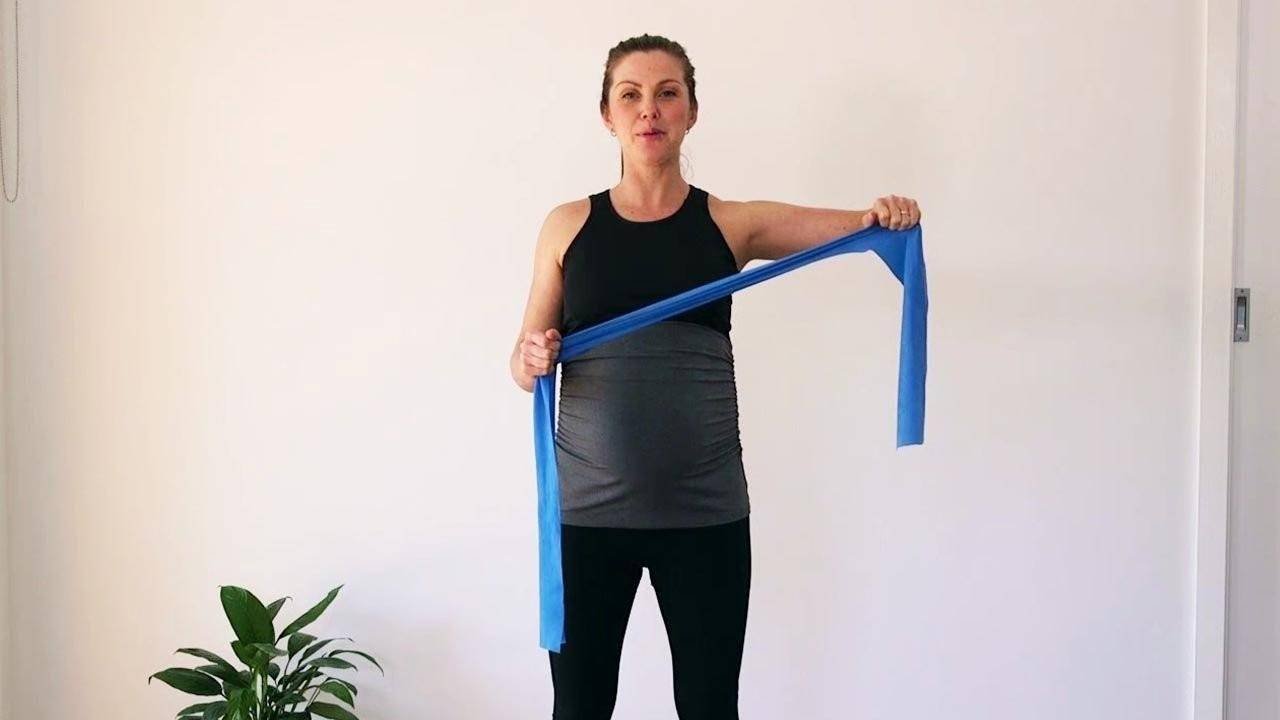
Resistance bands during pregnancy are a fantastic tool for building strength, improving flexibility and improving overall fitness without putting undue stress on your body.
Join me as I guide you through a series of safe and easy exercises you can do at home, ensuring you maintain your fitness journey during pregnancy.
We’ll cover modifications for different trimesters, tips for proper form, and the benefits of resistance training during pregnancy.
Be a strong mom
Whether you’re a seasoned fitness enthusiast or a beginner, these resistance band workouts will help you feel strong and energized throughout your pregnancy.
Remember to consult your healthcare provider before starting any new exercise regimen.
Safe Pregnancy Workouts
It’s important to know how to safely use a resistance band when you’re pregnant.
Resistance band exercises are a great piece of equipment that is versatile, takes up little space, lightweight, easy to use and effective and allows you to exercise in the comfort of your own home.
A resistance band can be tubular in shape or a flat piece of latex resistance band.
There are many different styles, lengths, brands and different resistance levels.
I often use bands in our studio pregnancy exercise classes and add variety to the entire workout. You can buy them at many sporting goods stores, online or even at drugstores.
Why Use Resistance Bands?
1. Easy to carry or carry in bag.
2. Relatively cheap purchase.
3. Can be used at home when traveling.
4. Resistance bands can be used to strengthen all muscle groups.
5. They can be used for physical therapy, light strength training in pregnancy or heavy resistance training.
6. They can be used by both athletes and the general population.
7. They are used to increase motor function and strength.
8. Resistance bands are often used for muscle training and rehabilitation after injury.
Prenatal exercise band workout
Benefits of resistance band exercises
1. Better posture.
2. Improve balance.
3. Body awareness.
4. Improve coordination.
5. Increases your muscular endurance and power.
6. Improve your flexibility.
7. Provides low impact training.
8. Resistance training for motor function impairments.
9. Postural Disorders Education.
10. Resistance training for muscle performance impairments.
11. Prenatal stretching exercises for muscle length disorders.
12. Balance training for balance and gait problems.
13. Functional and sport-specific training for functional limitations.
Why resistance bands are perfect for pregnancy
1. Joint Friendly (No Impact)
2. Easily adjust volume as you get stronger or tired
3. Portable and cheap
4. Allows you to continue strength training without heavy weights or cone hazards
General rules for all quarters
1. Choose medium light zones.
2. Never wrap the belt around your abdomen.
3. Avoid pulling the band across the midline in the next pregnancy if the bump is pressing.
4. Stop immediately if you experience cramping/discharge, leakage, pelvic pain or heaviness.
5. Exhale with effort, inhale on release – never hold your breath.
6. Stand on the band or anchor it to a door/post at chest height or lower – never pull from above after ~20 weeks (dislocation risk + supine if you lose balance).
Are you allergic to latex?
If you have one latex allergy then you can buy special latex-free Resistance tapes.
Evaluate your attitude
1. Stand in front of an outward facing wall.
2. Stand with your feet hip-width apart.
3. Slowly move backwards until you touch the wall.
4. Your shoulders, buttocks and the back of your head should touch the wall.
Exercises to avoid with bands while pregnant
1. Overhead triceps extensions or pulldowns (cone hazard + balance)
2. Any supine band exercise (eg banded leg lowers) after 16-20 weeks
3. Deep bends with a ribbon (eg full body choppers)
4. Very heavy resistance in crunches or Russian twists
Quick 15-Minute Pregnancy Zone Daily Routine (2nd and 3rd Trimester)
1. Band squat or hip thrust – 15 reps
2. Seated row or pull-aparts – 15 repetitions
3. Lateral leg raises or clams – 15/side
4. Half Knee Palloff Press – 10 slow/lateral
5. Diaphragmatic breathing with tape around the ribs + pelvic floor drops – 10 breaths
Do this 3-5 times a week and you’ll stay strong, reduce back/pelvic pain, and be better prepared for labor and postpartum recovery.
How to choose the best resistance band for you:
Your goal is to choose the resistance band according to the resistance level that is most suitable for you.
Resistance zones are generally color coded as follows:
1. Yellow belts exercise:
3 pounds. (1.3kg) of pressure when stretched to 100%
4.3 lbs. (2kg) when stretched to 200%
2. The red belts exercise:
3.7 lbs. (1.7kg) of pressure when stretched to 100 percent
5.5 lbs. (2.5 kg) when stretched to 200 percent
3. Green belts exercise:
4.6 lbs. (2.1 kg) of pressure when stretched to 100%
6.7 lbs. (3kg) when stretched to 200%
4. Blue bands exercise:
5.8 lbs. (2.6kg) of pressure when stretched to 100%
8.6 lbs. (3.9kg) when stretched to 200%
5. Black bands exercise:
7.3 lbs. (3.3kg) of pressure when stretched to 100%
10.2 lbs. (4.6kg) when stretched to 200%
There are additional colors available with higher resistances.
However, these are more often used in high endurance situations and don’t really apply to the natural state of pregnancy.
How to use a resistance band
Resistance bands are safe to use as long as you follow a few safety tips. The safety of the band is the first important task.
Depending on the exercise you are performing, you can attach the band to a fixed point on the wall or to a stationary machine.
The important part is to ensure that you attach it to an immovable structure. Perform all exercises with correct technique and correct posture.
Make sure you can stand with your back straight, shoulders and hips aligned. Deal with it stomach muscles.
How to hold a resistance band
The next important step is to make sure you grip the belt properly and securely so it doesn’t slip out of your hands.
The best technique is to place the resistance band in the area between your thumb and forefinger.
The majority of my online workouts require no equipment. But I also like to use resistance bands, so I’ve included some workouts if you have that equipment at home.
Choosing the right resistance band
When choosing a resistance band for pregnancy workoutsit is essential to choose one that matches your current fitness level and stage of pregnancy.
Bands come in different resistance levels, usually indicated by color, with the lighter resistance being ideal for beginners or for exercises that require more stretching.
Heavier resistance bands offer a greater challenge for stronger muscle groups or those with a higher level of fitness.
It is also important to consider the type of resistance band.
Some are flat, while others are tubular, and some have handles. Grips can provide a better grip, which can be helpful as pregnancy progresses and grip strength changes.
Always make sure the tape is free of defects such as cracks or tears to avoid injury. If in doubt, consult a fitness professional or health care provider to find the most appropriate resistance band for your pregnancy training regimen.
Top resistance band exercises
During the first trimesterfocus on exercises that promote stability and core strength, such as standing rows and lateral band walks. These exercises help build a solid foundation for the changes your body will undergo.
At second trimesteryou can incorporate gentle pull-aparts and leg presses, which can be performed sitting or lying on your side to avoid putting pressure on the vena cava.
As you proceed to third trimesterexercises should continue to emphasize stability while accommodating your growing belly.
Modified pregnancy squats with band, seated rows and arm exercises can help maintain strength without compromising comfort or safety. Remember to always listen to your body and adjust the resistance or skip exercises if they cause discomfort or feel uncomfortable.
Resistance band safety tips
Safety is paramount when exercising during pregnancy. Always start with a warm-up to prepare your muscles and joints, and choose a resistance level that allows you to complete exercises with good form.
Avoid any movements that involve lying on your back after the first trimester, as this can restrict blood flow.
Watch your balance as it can be affected by pregnancy and use a chair or a wall for support if needed.
Stay hydrated
It is important to stay hydrated, avoid overheating and stop exercising if you feel dizzy, nauseous or in any pain. Check resistance bands regularly for wear to prevent them from snapping during use.
Finally, always check with your healthcare provider before starting any new exercise routine during pregnancy to make sure it’s safe for you and your baby.
Resistance band exercise program
To effectively incorporate resistance band exercises into your pregnancy fitness routine, aim to include workouts that target all major muscle groups. This can include a combination of upper body, lower body and core exercises.
Start with a lower frequency and shorter duration, gradually increasing as your body adjusts to your exercise routine.
It’s beneficial to combine resistance band exercises with other forms of prenatal exercise, such as walking or prenatal yoga, for a well-rounded fitness approach.
Consistency is key
Consistency is key, so try to create a regular workout routine, but also be flexible and willing to adjust your routine as your pregnancy progresses.
Track how your body feels during and after your workout and use that feedback to adjust your exercise program.
Above all, focus on enjoying movement and the positive impact it has on you and your baby’s well-being.
