


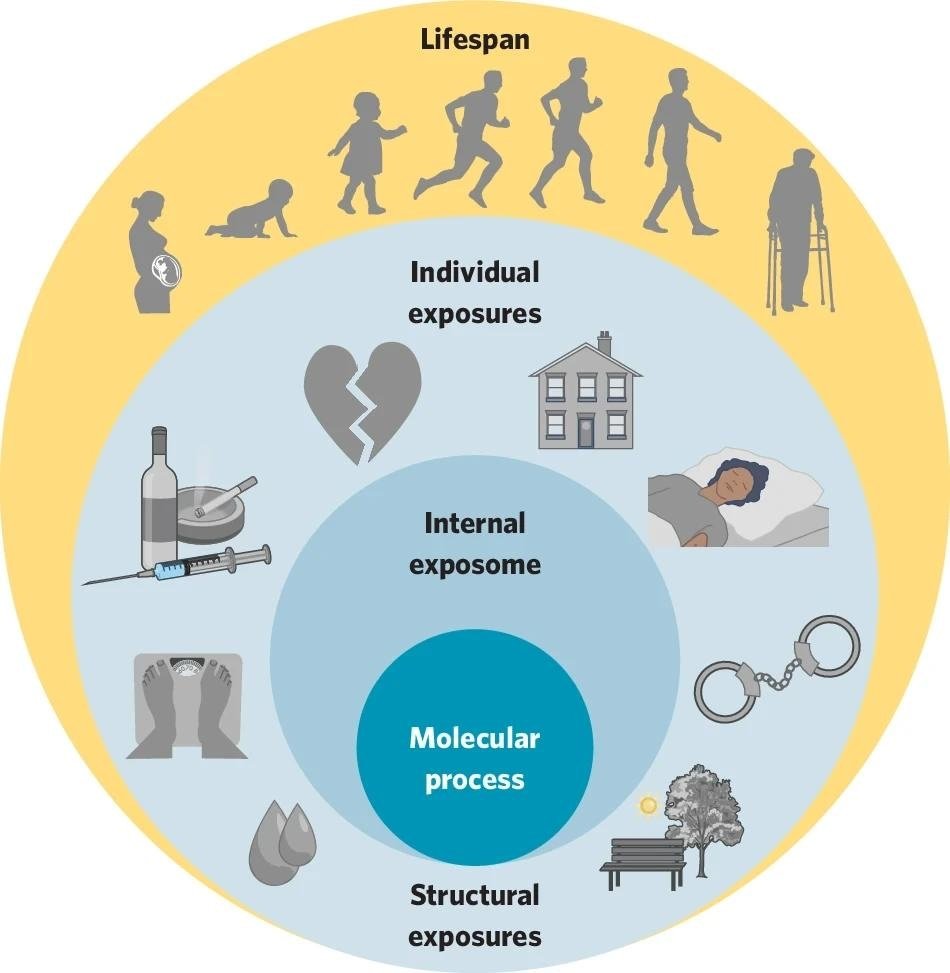
A new perspective argues that understanding the lifelong web of environmental exposures, from early childhood to older age, could unlock more precise strategies to prevent mental illness and improve mental health care.
Throughout the lifespan, external exponents—including individual and structural exposures—become incorporated into the body as the internal exponent. These dynamic exposures interact at critical life stages, influencing biological processes and shaping downstream health outcomes.
In a recent perspective published in the journal Neuropsychopharmacologythe researchers suggest that understanding environmental exposures across the lifespan can help transform mental health research and clinical care.
The multidimensional framework, which includes physical, chemical, social and structural factors, captures non-genetic influences on mental health, especially during sensitive periods such as childhood, adolescence and old age. Combined with social determinants of health (SDOH), this approach moves beyond descriptive correlations. It can enable researchers and clinicians to identify at-risk individuals, tailor interventions, and inform policies that support precision prevention, personalized care, and improved equity in mental health outcomes.
Mental health reflects a dynamic interplay between genetic and non-genetic (environmental) factors that shape individual disease risk. Although genetic factors are increasingly understood, environmental exposures remain crucial as they can be modified and targeted for prevention and intervention. Historically, capturing these interactive displays has been challenging. With modern measurements and analyses, researchers can better capture environmental exposures, assess their impact on mental health, and guide interventions that promote equity and effective public health.
About perspective
This perspective frames the exposome as a holistic framework that captures environmental factors that influence health across the human lifespan, highlights their complexity in research, and outlines future directions for research and clinical translation to guide mental health strategies.
The report links environmental factors to health outcomes
The report refers to a multidimensional framework for understanding the impact of environmental factors on health across the lifespan. It includes physical, chemical, behavioral, social, and structural exposures, linking them to biological processes such as oxidative stress, metabolic derangement, and epigenetic changes that contribute to disease development. The report integrates these pathways, linking environmental exposures to health outcomes.
The framework is organized into external and internal sectors. The external component of the exhibit includes factors in the surrounding environment, both at the individual and structural levels. Individual-level factors include diet, physical activity, substance use, and adverse experiences, while structural-level factors reflect broader social conditions, including neighborhood disadvantage, availability of green space, air quality, state legislation, and national economic indicators such as GDP. Internal exposure includes endogenous factors, such as the microbiome, metabolic processes, and inflammation, that reflect the body’s biological responses to environmental exposures.
SDOH closely related and overlapping with exposure, including education, socioeconomic status, employment, social networks, housing stability, food security, child abuse, and immigration policies. By examining exposures at the individual and societal levels, the exposure approach helps researchers and clinicians identify modifiable risk factors, guide targeted interventions, and inform policies that promote health equity. This holistic perspective highlights the potential of environmental research to advance precision prevention and personalized care.
Exponential complexity throughout life
Understanding mental health requires an appreciation of the complexity of exposure, including the cumulative and interacting effects of multiple exposures and individual variability in response. Differential susceptibility theory suggests that individuals respond differently to environmental exposures based on their unique biological and psychological makeup, highlighting the need for multidimensional data-driven methods that capture both protective and risk-enhancing factors.
Exposure time is equally critical. The theory of sensitive windows highlights periods of increased vulnerability to environmental influences. In early childhood, maternal nutrition, stress, and exposure to toxins such as heavy metals, pesticides, and endocrine disruptors can shape neurodevelopment and long-term mental health. Adolescence is another key period as brain maturation interacts with the school environment, peer influences, digital exposure, and risky behaviors, all affecting emotional well-being and psychiatric outcomes.
Adulthood introduces lifestyle and work pressures, urban pollution and chronic stress, increasing the risk of anxiety, mood disorders and other mental health challenges. In older age, social isolation, loneliness and reduced engagement are prominent factors contributing to mood disorders, cognitive decline and dementia risk.
Combining differential susceptibility and sensitive period theories, the exposure approach captures the evolving effect of environmental exposures across the lifespan. This perspective informs research, prevention, and interventions tailored to individuals’ unique vulnerabilities, supporting precision strategies that account for both the timing and complexity of environmental influences on mental health.
Future directions
The exponential approach captures the full range of environmental factors that influence mental health across the lifespan. By integrating these exposures rather than examining them in isolation, researchers can link environmental factors to biological processes and uncover new interactions that contribute to mental illness.
Data-driven analytical approaches, including exposure-level correlation studies (ExWAS), allow researchers to systematically assess large numbers of environmental exposures simultaneously and identify previously unrecognized environmental risks and resilience factors. Longitudinal, multi-omic and genetically informed study designs, along with standardized tools and datasets such as electronic health records (EMR), is key to promoting reproducibility and generating generalizable information.
Clinically, incorporating exponential and SDOH The data can allow providers to identify individuals at risk, tailor interventions to modifiable factors, and educate patients and families about potential environmental risks. Individualized strategies may include lifestyle changes, reducing exposure to pollutants or stressors, and connecting patients to community resources that support well-being. Genetically informed analytic approaches such as twin studies, family designs, and Mendelian randomization can further elucidate how environmental exposures interact with genetic susceptibility to influence mental health outcomes.
Emerging areas such as digital exposure, including social media use, online stressors and artificial intelligence (All included) interactions, further expand the understanding of environmental influences on mental health. Combining rigorous research with real-world application, this framework provides a potential roadmap for precision prevention, personalized care, and a more equitable future in mental health.
