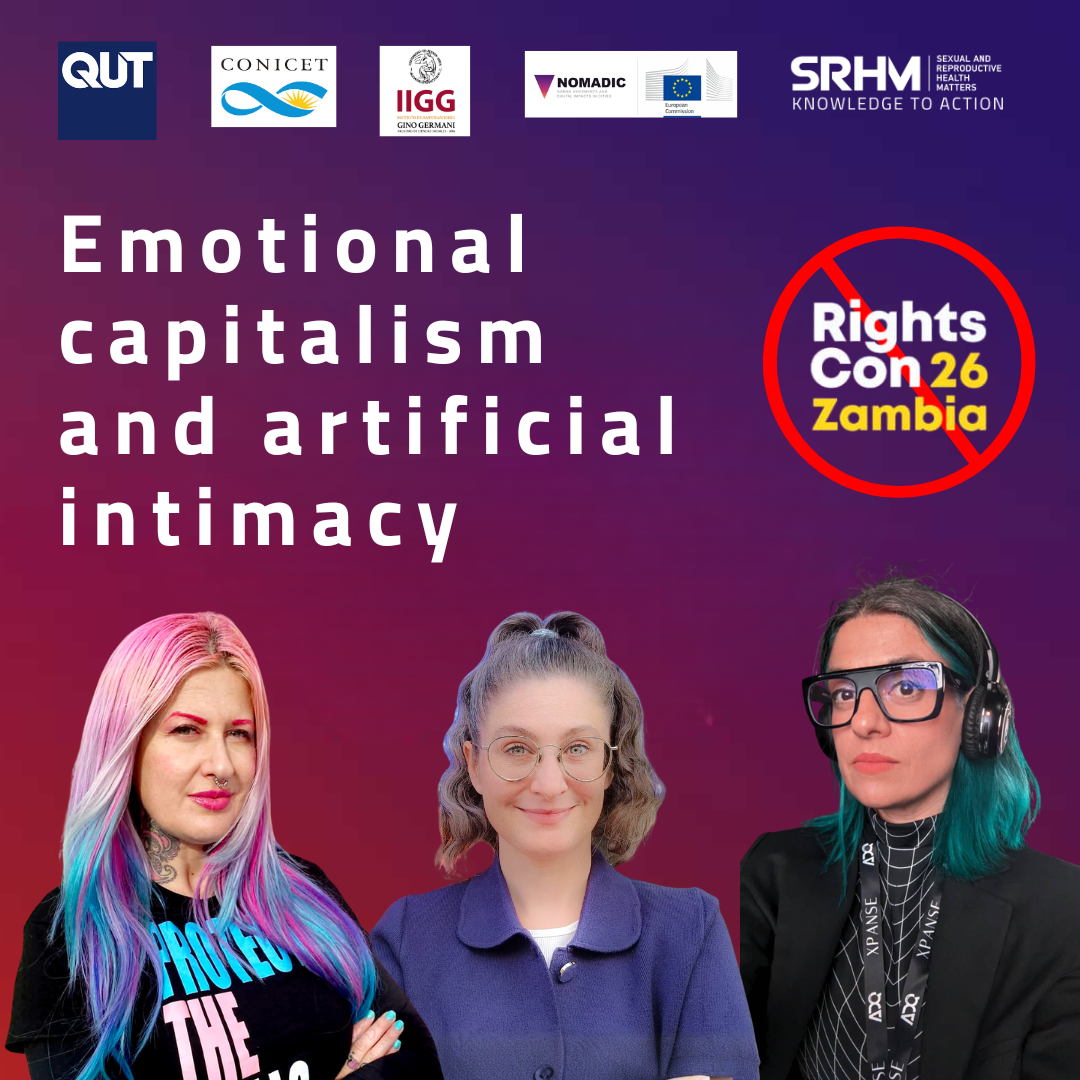
What does intimacy mean in a world increasingly shaped by artificial intelligence?
This recorded discussion brings together critical perspectives on the rise of artificial intelligence companions, chatbots, and other technologies that promise connection, care, and even love. While these systems are often framed as solutions to loneliness or social isolation, the debate pushes beyond this narrative to consider the political, economic and ethical dimensions that underpin them.
Speakers reflect on how many AI systems are built on mining and profit-driven models that prioritize engagement over prosperity. Rather than simply asking whether these technologies are “safe,” the debate requires deeper questions about who designs them, who they serve, and whose interests are embedded in their development. From shifting language from ethics to security, to the global push for deregulation in the name of innovation, the panel highlights how power works in the context of AI governance.
At the same time, the discussion opens up alternative possibilities. Drawing on feminist, queer, and decolonial perspectives, speakers share examples of technologies rooted in collective care, community responsibility, and political memory. These include chatbots designed to challenge gender bias, preserve stories of violence, or support people in navigating difficult conversations without replacing human relationships.
A key issue is infrastructure. Even the most well-intentioned initiatives often rely on platforms and systems controlled by large corporations, raising urgent questions about ownership, dependency and digital sovereignty, particularly in the Global South. Building a fairer technological future will require not only rethinking design, but also investment in community-led local infrastructure.
Ultimately, this discussion calls us to move beyond seeing artificial intelligence as inevitable or neutral. Rather, it encourages the reimagining of technology as something that can and should be shaped in the service of human flourishing, collective care, and environmental responsibility.
Watch the recording above to explore how artificial intimacies are reshaping our social worlds and what it might take to reclaim them.
Resources:
Speakers
Moderator: Dr Zahra Stardust
 Dr Zahra Stardust is a white, queer, female settler working on the stolen lands of the Yugara and Turrbal peoples. Her work specializes in sexual media and sextech, focusing on the politics of policing sexual content (including the production, distribution and regulation of explicit media) and the design and governance of digital technologies. Her book Indie Porn: Revolution, Regulation and Resistance (Duke University Press, 2024), explored how governments and platforms regulate sexual media, and her next book Sexttech: A Critical Introduction (Polity Press) examines the role of capitalism, colonialism, and carceralism in contemporary sextech. He participates in the Sexual Justice Initiative of the World Association for Sexual Health and is a member of the Advisory Group on Sexual Health and Well-Being of the World Health Organization. Her current project, funded by the Australian Research Council, explores how digital platforms can better protect sexual and reproductive rights online. He is a lecturer at the Queensland University of Technology and a former fellow at the Berkman Klein Center for Internet and Society at Harvard Law School.
QUT – Academic Profiles – Dr Zahra Stardust
Michaela Mantenia
 Known as “Abogamer,” Micaela Mantegna (AR) is a video game attorney and activist known for her expertise in digital ethics, augmented reality (XR) policy, and the complex intersections of artificial intelligence, creativity, and copyright law. Author of ‘ARTficial: creativity, AI and copyright’ (2022) and the influential essay ‘ARTificial: Why Copyright Is Not the Right Policy Tool to Deal with Generative AI’, her work deeply explores the effects of digital capitalism, at the intersections of intellectual property, AI, art and eth.
In 2022, Micaela was selected for the prestigious TED Fellowship, with her TED talk gaining over 1.5 million views worldwide. He was a fellow at the Berkman Klein Center at Harvard University, and also served on Chatham House’s Artificial Intelligence Working Group, the Metaverse Council of the World Economic Forum.
Building on her previous work on artificial intelligence and creativity, she coined the framework of “Technocapitalism of Intimacy” to critique the commodification of simulated connection in digital ecosystems, pointing to artificial empathy as the “third wave of artificial intelligence” designed to mimic human characteristics. He has presented keynotes and lectures in more than 28 countries, at conferences such as GDC, TED, GamesBeat Summit, Ada Lovelace Festival, World Summit on Arts and Culture, Vancouver Biennale, RightsCon, DLD, Internet Freedom Festival, etc. Her work has been featured in The Verge, WIRED, Le Monde outlet and more.
Micaela curates the Substack ‘Braindancing in the #Metaverse’, critically following developments in augmented reality, artificial intelligence and the geopolitics of digital technologies.
Dianela Gahn
 Dianela Gahn is a sociologist and interaction designer working on urban research, gender, sociotechnical systems, and with a growing interest in artificial intelligence governance. She is a CONICET researcher and PhD candidate at the University of Buenos Aires (UBA), affiliated with IHUCSO Litoral and IIGG. She is also a researcher in the NOMADIC project (Horizon Europe), studying how urban platforms mediate sociality and shape encounters in physical and digital spaces. Beyond academia, he works as an independent consultant in service design and public innovation.
Contact:
[email protected]
[email protected]
A RightsCon session hosted by Sexual and Reproductive Health Matters (SRHM), in partnership with Queensland University of Technology (QUT), following the cancellation of RightsCon 2026.