


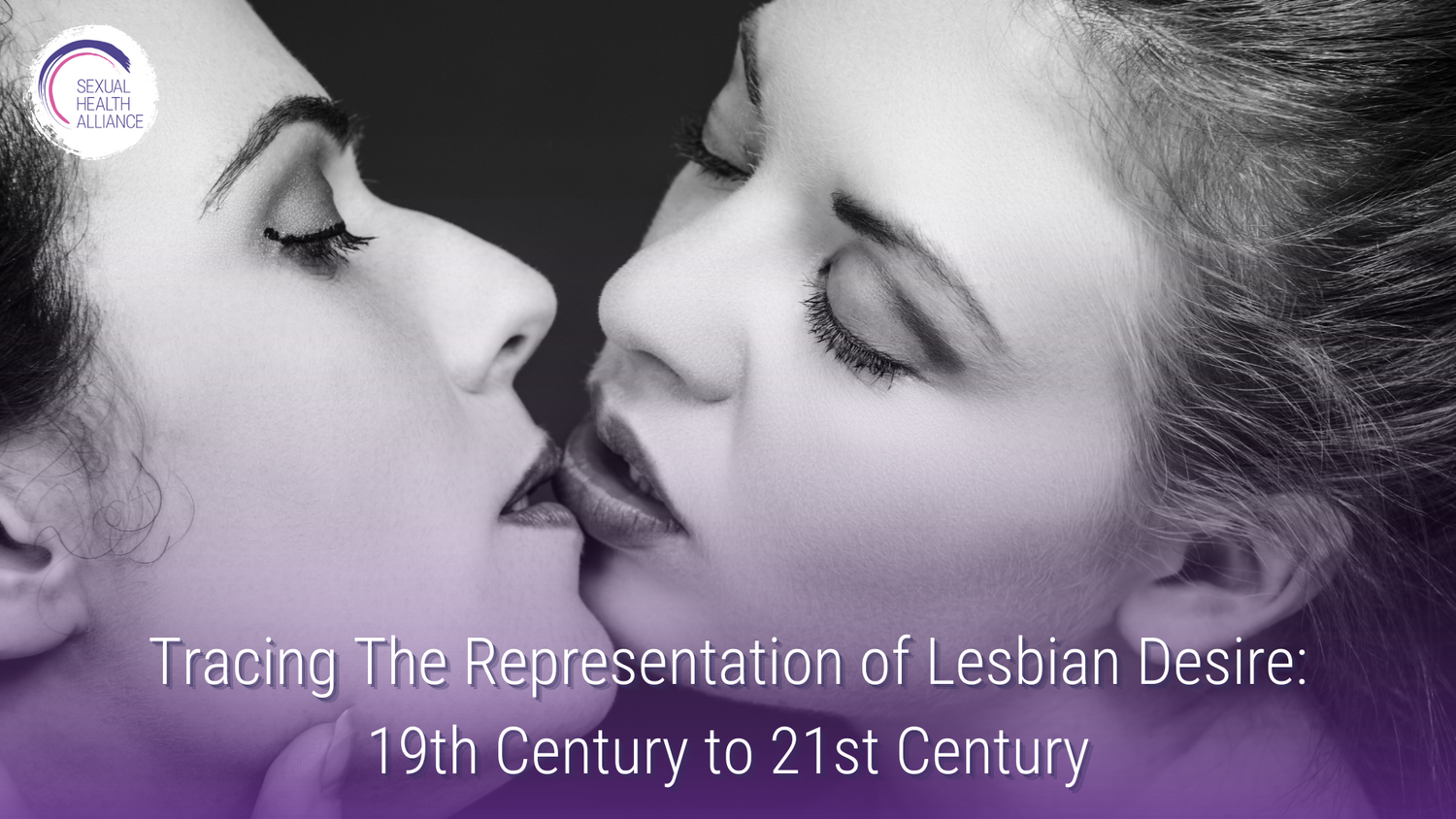
“Visibility isn’t about power or control, it’s about being seen, acknowledged and validated,” says queer artist Jeanette Spicer. This profound concept encapsulates the journey of lesbian representation in art, moving from imagination driven by the male gaze to authentic expression. How has the depiction of lesbian desire evolved to reflect changes in artistic expression, social acceptance, and impact on lesbian identity? The first time I encountered an artwork coded as “queer” was in 2013 when I was thirteen. The artwork, a photo of two topless women kissing in an issue of Playboy, left me feeling strangely upset. This marked the beginning of my journey towards understanding my sexuality. Currently, male gaze pornographic lesbian art doesn’t feel authentic to me. It reads as a fictional representation of lesbian desire, with the intended audience being men who see lesbian sex as a vehicle to satisfy their desires. No question Porn may be art, but it isn’t always.
In 2024, there are many more lesbian art builds available. I resonate most with artists who are queer themselves, as representation shines through and resonates deeply with me. The question of authentic representation in art depicting lesbian desire has always been present, between the male gaze and societal stigmas against same-sex desire. It is interesting to see how this Sapphic art has evolved, highlighting that authentic depictions of queer desire have always been and will always be present. To fully see the evolution, I wanted to look at a historical depiction of lesbianism and a contemporary one. I chose the painting Sappho and Erinna in a Garden at Mytilene (1864) by Simeon Solomon because of its iconic quality. For the contrast of the modern image, I chose a piece from the work of Jeanette Spicer (one of my favorite artists) “What does it mean to be here” (2021).
Historical Context of Lesbian Codified Art
To effectively trace the evolution of lesbian coded art, it is necessary to highlight the historical context of each work, beginning with that of the 19th century. Society during the 1800s was predominantly patriarchal and heteronormative, with strict gender roles and expectations that marginalized “non-conforming” identities. Lesbianism was largely considered taboo and deviant behavior in 19th century society. Artists of this period followed strict moral codes and social taboos surrounding same-sex relationships, resulting in veiled or allegorical depictions of lesbian desire and intimacy. Lesbian desire was not allowed to be openly. Any art depicting queer desire in any form had to be coded in a way that could have multiple interpretations.
Beyond paintings, lesbian desire is subtly woven into various other art forms. In literature, for example, writers such as Sarah Orne Jewett and Mary Wilkins Freeman incorporated queer subjects into their stories, depicting deep, loving relationships between women. Artists of this period followed strict moral codes and social taboos surrounding same-sex relationships, resulting in veiled or allegorical depictions of lesbian desire and intimacy. Open depiction of queer desire was not allowed, necessitating art that could have multiple interpretations. The legal and social consequences for artists who dared to explore queer themes were severe. They risked social ostracism, legal prosecution, and even imprisonment. The oppressive environment forced many artists to mask their true intentions, imbuing their works with layers of meaning that could only be understood by those who shared similar experiences.
lesbian desire: Introduction to “Sappho and Erinna in a Garden at Mytilene”
In Sappho and Erinna in a Garden in Mytilene, Simeon Solomon offers a penetrating meditation on female desire and intimacy, combining elements of classical mythology and symbolic expression. This work of art encapsulates the tender relationship between two poets of Sappho and Erinna. What is most interesting about this painting is the story of the painter himself. Simeon Solomon was a gay Jewish artist living in Victorian England. In this sense, the construction of the painting does not fall victim to the typical heterotypical male gaze. While Solomon was not a queer woman himself, he was a queer man and as a result, the representation of lesbian desire has a more authentic feel. The main strength behind the painting is the way Solomon explores themes of female desire and intimacy through the subtle interplay between Sappho and Erinna.
It is first useful to analyze the symbolism of Sappho, as she has been coined as the “Woman who has left ripples throughout queer history.” Although there is no concrete evidence that Sappho was queer, many historians, writers and artists believe that her symbolism is so queer-coded because of her obvious queerness [and that] the community itself refused to let it fade into heterosexual obscurity. After all, Sappho lived on the Greek island of Lesvos and her reputation for loving women and the name of the island led to the creation of the word “lesbia”. The painting itself depicts Sappho embracing her fellow poet Erina in a garden at Mytilini on the island of Lesvos. This can be interpreted as a subtle message hinting at same-sex desire. It is within this framework of coded messages that “Sappho and Erinna” can be seen for what it was: a depiction of lesbian desire and Sapphic relationships.
Queer Art 21st Century + Symbolism
In the 21st century, where queer representation in art is more normalized, artists do not need to rely on symbolism and veiled imagery to depict same-sex desire. Of course, much contemporary art features symbolism, but it typically outwardly represents queer desire rather than subtly alluding to it. Throughout history, queer artists have often faced marginalization and censorship, among other struggles. The 21st century has brought increased visibility and acceptance of queer art in various media. The context in which 21st century works are perceived is very different from how queer art was perceived in Solomon’s time.
Within this setting is the work of Jeanette Spicer. She is a contemporary artist based in New York who works in videography, photography and other mixed media to engage and interact closely with the people in her life. Her work portrays marginalized lesbian identities through a raw, realistic lens. One of her goals is to challenge viewers to rethink the concept of intimacy and relationships by creating a world where bodies can be free to explore the space around them and the people who share that space with them. Speaking about her work, Spicer notes that “...something that is becoming more and more important is the lesbian gaze and challenging and addressing the lack of lesbian representation.” In this sense, it is immediately apparent that Spicer’s work expands on the echoes of queer desire in Solomon’s through a modernized lens. The question of accurate lesbian representation remains even as Spicer’s work exists in a world that has evolved since the depiction of Sapphic desire in the nineteenth century, but still has a ways to go.
Lesbian Desire: Gender Roles Analysis
In the 19th century example, there is the presence of a kind of heteronormative gender structure. Sappho, seated on the right with a golden drapery takes on a dominant more masculine appearance as she embraces Erina. Erinna on the other hand looks more subdued and overtly feminine, dressed in a pink dress that slips ever so slightly off her shoulder, almost revealing her breasts. Sappho also appears more masculine in her facial features, while Erinna appears softer and more feminine. This clear gendered representation of same-sex desire is likely a result of the period, an ideology that still exists today. Society is still struggling to wrap its head around the idea that there isn’t necessarily a “man” and “woman” present in a lesbian relationship. Sometimes both women are female, sometimes male. Solomon was already pushing the boundaries with this coded message of female desire. I’m not sure it ever occurred to him to portray the woman as equally feminine or masculine.
Spicer provides evidence that juxtaposes Solomon’s heterogeneous portrayal of lesbian desire. This is partly due to the modern birth date of her work as opposed to Solomon’s 19th century painting. There are no echoes of the male gaze, be it the typical straight gaze or the unique gay male gaze, present in Spicer’s work. This is because her work is so raw and appealing to those in the queer community. seems like a more accurate representation. The particular photo I chose echoes this sense of romance that Solomon’s work projects. The fact that these two works convey a romantic desire in such different ways shows the historical evolution of how queer intimacy is portrayed in art.
The future: Art, representation and lesbian desire
Overall, the journey of queer art from the 19th century to the 21st century demonstrates a strong sense of resilience and creativity. This development reflects a growing queer visibility, while also acknowledging the marginalization and oppression that queer people still face. The journey towards full and authentic queer visibility in art is far from over, but it is heartening to see the significant progress that has been made over the centuries. Looking ahead, it is exciting to envision future directions for lesbian representation in art. Emerging artists and trends have the potential to further transform the landscape, promoting a richer and more inclusive narrative.
Artists like Spicer are already rewriting the narratives shaped by the male gaze and Playboy imagery, offering new perspectives that challenge and redefine these representations. Representation in art is vital. not only does it influence and reflect cultural changes in the understanding of sexuality and gender, but it also allows queer people to connect deeply with art and trace the genealogy of their identities. As we move forward, the continued expansion of diverse and authentic queer representation in art will no doubt be instrumental in shaping a more inclusive cultural understanding.
Curious about your path in the evolving field of sexuality? Let’s find out which SHA certification is for you. Take ours “Shape the Future of Sexuality: Which Certification Is Your Calling?” quiz and embrace your future role in shaping sexuality education.
Author: Alyssa Morterud
