Transactional sex in forced displacement contexts is widely discussed, but too often framed through narrow lenses. It is often confused with terms such as trafficking, exploitation or sex work and approached through moralizing or criminalizing narratives that obscure lived realities.
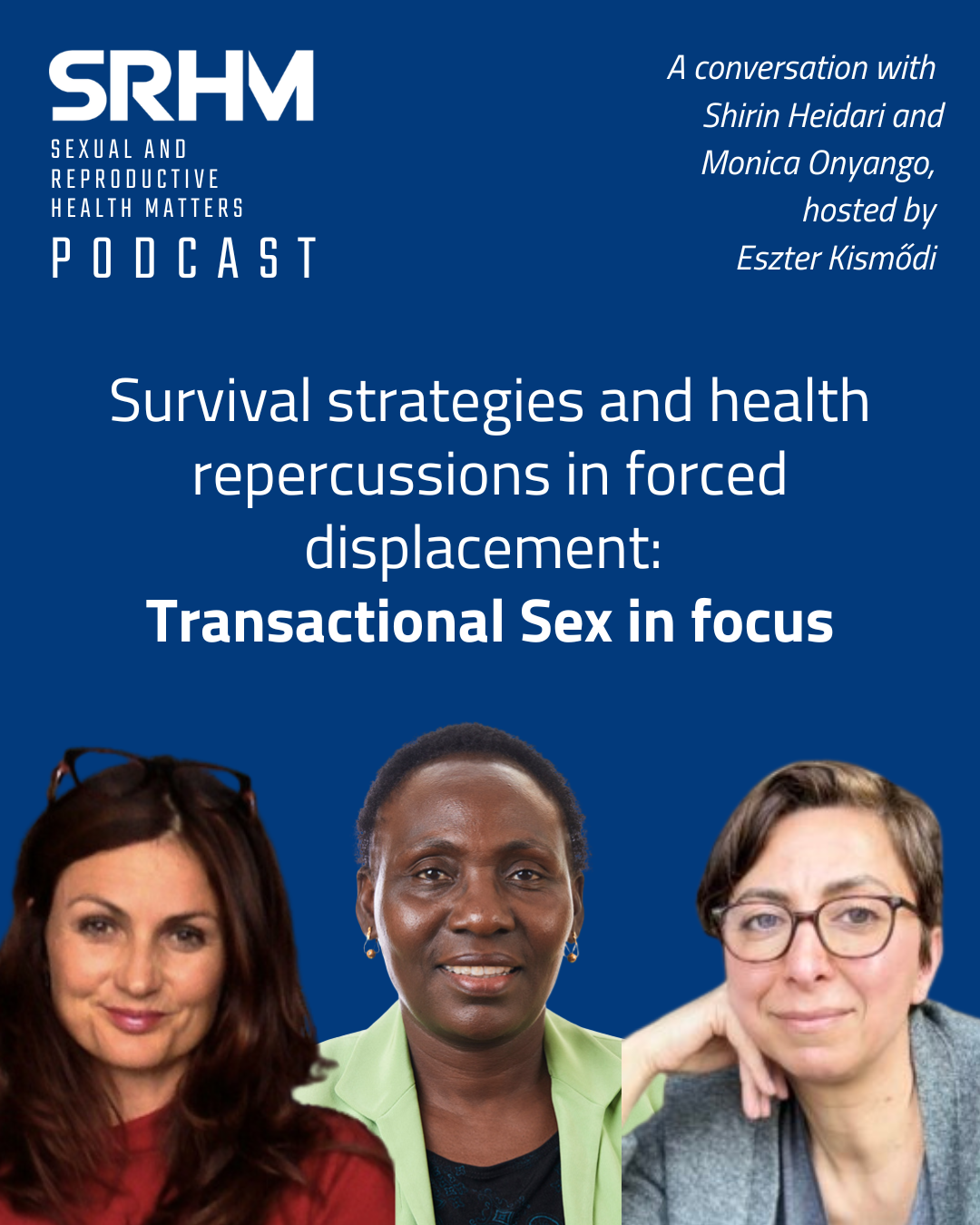
In this episode of Sexual and Reproductive Health (SRHM) Podcast.Eszter Kismődi talks to Dr Shirin Heidari, its principal investigator and coordinator Liminality Research Consortium hosted by the Gender Center at the Geneva Graduate Institute and Professor Monica A. Onyango, Co-Principal Investigator at Boston University School of Public Health, on the recent multi-country study, Survival strategies and health impacts in forced displacement, with transactional sex in focus.
The study was conducted between 2021 and 2024 in Jordan, Lebanon, Turkey, Greece and Switzerland, and the report was published in October 2025 by the Liminality Research Consortium.
They discuss how transactional sex unfolds within the structural conditions of forced displacement and why conceptual clarity, intersectionality, and a rights-based analysis are essential to understanding it.
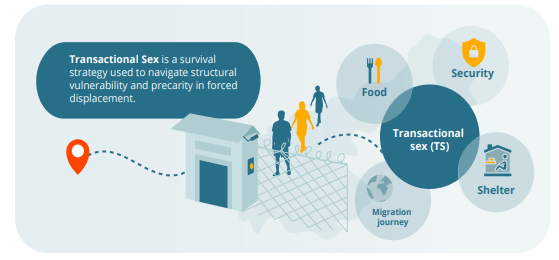
 The conversationabout sex trafficking situations within wider political and humanitarian dynamics: shrinking protection space, restrictive asylum regimes, precarious legal status, limited access to employment, housing insecurity and reduced funding for health and social services. In many settings, IDPs live in prolonged uncertainty—waiting months or years for recognition, navigating fragmented services, and facing daily survival challenges. In these circumstances, Transactional sex does not appear as an isolated phenomenon, but as one of many coping and survival strategies shaped by structural constraints.
A central theme in the debate is the need to move away from simplistic binaries between ‘choice’ and ‘power’. Lives in displacement are complicated. Agency and vulnerability coexist. Individuals navigate highly constrained environments shaped by border regimes, poverty, gender inequality, xenophobia and gender rhetoric. Decisions are often pragmatic responses to immediate needs—food, shelter, protection, forward movement, or documentation—made in systems that severely limit available options. Acknowledging this complexity does not normalize exploitation. Rather, it allows for a more accurate and human understanding of what people are dealing with.
The episode also explores how these structural drivers intersect with health outcomes. Participants in the underlying research described sexual and reproductive health consequences, including vulnerability to HIV and other sexually transmitted infections, unintended pregnancies, unsafe abortions, exposure to sexual and gender-based violence, and significant mental health stress associated with chronic insecurity. The discussion highlights how implicit humanitarian responses – where legal support, protection, housing and sexual and reproductive health services operate in isolation – fail to reflect the interconnected nature of people’s lived realities.
In the current global context, characterized by increased immigration controls, rising xenophobia, anti-LGBTQI and anti-gender rhetoric, and funding constraints, these issues become even more urgent. Transactional sex cannot be treated as a peripheral concern or an afterthought once the “essential services” are delivered. It is embedded in the structural conditions of displacement itself. Addressing it requires conceptual clarity, integrated service delivery and engagement with affected communities in shaping policy and practice.

For SRHM, this conversation highlights its importance centering lived experiences, resisting ideological simplifications and linking evidence to drastic change. Transactional sex in forced displacement is at the intersection of migration governance, humanitarian policy, gender inequality, and sexual and reproductive health and rights. Creating space for informed, interdisciplinary dialogue is a necessary step toward more coherent and rights-affirming responses.
🎧 Listen to the full episode: SUrvival strategies and health impacts in forced displacement: Transactional sex in focus (36 minutes)
Also available in Apple Podcasts and YouTube.
Please note that blog posts are not peer-reviewed and do not necessarily reflect the views of SRHM as an organization.
SRHM is not responsible for and does not endorse, unless expressly stated, the content of external sites linked to the blog posts.