


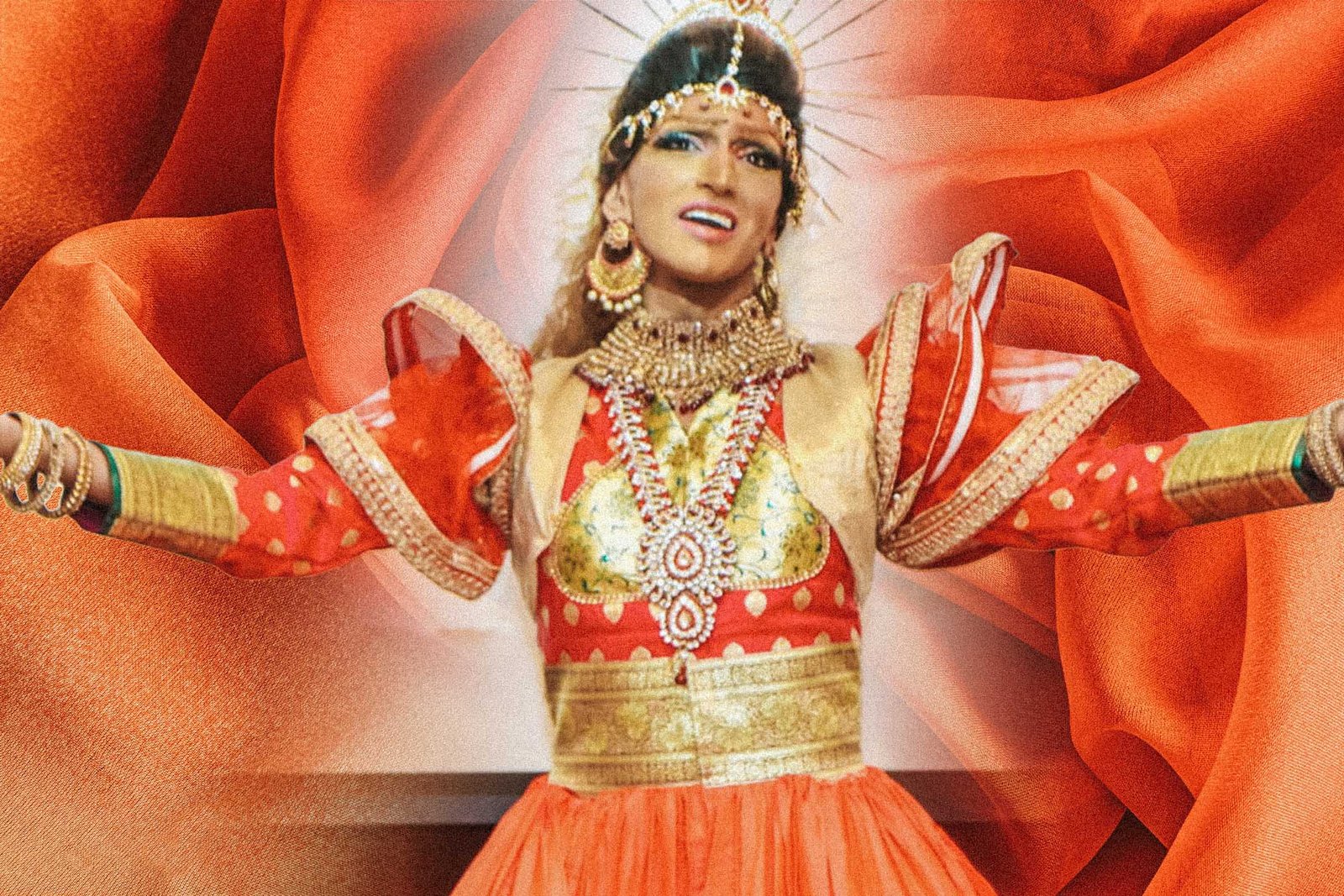
One night during Ramadan each year, more than 100 queer people make their way to the lesbian, gay, bisexual and transgender community center tucked away in New York’s West Village to break their fast. Iftar, marking the end of the day’s fast, draws people from all over the East Coast and as far away as California—all looking to celebrate the intersection of Muslim and queer culture.
Amid escalating anti-immigrant sentiment and politics in the US, some queer Muslims have voiced feeling ostracized from their communities and religious traditions. But this year, during Islam’s holiest month, New York’s LGBT Community Center marked a major milestone—the tenth anniversary of its annual iftar, where queer Muslims can celebrate their culture and break their fast in the safety of their community.
“Over the past decade, this event has remained a vital sanctuary where LGBTQ Muslims can fully embrace our intersectional and multicultural identities,” Mohamed Q. Amin, founder and executive director of the Caribbean Equality Project, said at the event. “In an era of increasing violence against immigrants and continued efforts to erase trans and queer people from public life, creating and protecting sacred spaces like this has never been more urgent.”
In the event’s main hall, twelve tables welcomed guests as speakers from the Center and its partner organizations introduced the event. Iftar then began at 7pm with the azan, or call to prayer. But unlike the traditional azan, where men lead the service, a queer woman—community organizer and educator Fazeela Siddiqui—led the LGBT Center’s azan. Canned water containers popped and echoed throughout the room as the group broke their fast together over bowls of dates.
In another of the event’s three halls, the crowd was entertained by speakers, drag shows, belly dancing and spoken word poetry over a hot, halal meal sourced from local Muslim restaurants and vendors. A gender-neutral prayer space was created in a separate room.
This year’s theme was “A Decade of Ummah,“which the Center defines as “the global community of Muslims linked by faith or culture” and featured artists from the last decade of its iftars.
“Our ummah, our community, continues to guide us in building a future based on uncanny courage and collective strength,” Amin said. “Ten years later, the LGBTQ community iftar stands as a living expression of repair, resilience and love, an ever-growing umma that nourishes body and spirit. And to every queer and trans Muslim whose life is threatened by war, imperialism, genocide and criminalization, we honor your existence and continue to fight for your freedom.”
In an interview ahead of this year’s event, the director of the New York State LGBT Health and Human Services Network Center, Louisa Benarbane, emphasized the need for “LGBTQ+ Muslims to really be in a space where they can be unequivocally themselves, but still be in a faith-oriented community.”
The iftar, which often sells out, is an act of resilience, Benarbane added.
The Center “makes sure that people in that lens of their faith still feel connected to their religion, their cultures and, of course, their identities because they’re not contradictions,” Benarbein said. “They are complementary.”
A decade of iftar at the Centre
The Center planned and hosted its first iftar in 2017, just months after President Donald Trump imposed a ban on travelers from seven Muslim-majority countries. Trump has targeted both queer people and the Muslim community in the years since, referring to The US population exceeds 4 million Muslims as negative, hateful and radical.
The annual iftar “was a direct response to the Muslim ban,” Benarbein said. Queer Muslims needed a space where they could be empowered and build community.
“There are LGBTQ+ Muslims, as well as differences of every faith[s]and we need special spaces to come together, not just as an act of resistance, but as an act of resilience,” Benarbane said.
Polls show mixed acceptance of lesbians, gays and bisexuals among Muslim Americans. In 2017, more than half of Muslim Americans reported acceptancebut the The Pew Research Center’s 2023-2024 Religious Landscape Study (RLS) showed that 41 percent said homosexuality should be accepted. The RLS found that only 36 percent of evangelical Protestants accepted homosexuality.
“LGBTQ people in religions and cultures have always existed,” Benarbane said. “We will always continue, and it is always the mission and goal of the Center to provide confirmed spaces for this.”
The Center’s iftar parties are organized with the help of a coalition of other LGBTQ+ community organizations that refuse to be “bumped into this monolith,” according to Benarbane, including the Caribbean Equality Project, Tarab NYC, SALGA NYC, and the Ayah Project. Over the years, iftars have become more and more popular.
Prominent activists and politicians have attended the foundation’s iftar parties in the past, including Shahana Hanif, the first Muslim woman elected to the New York City Council, and former New York State Assembly member Zohran Mamdani.
Mamdani, who has since become New York’s first Muslim mayor, did not attend the iftar this year, but instead sent a video message that was played for the Center’s iftar attendees before they broke their fast.
Iftars have also explored many themes related to what those in the community experience. Last year, the theme was ‘Joy & Resilience as Resistance’. Benarbein said the event raised awareness about it pink washphenomenon where homophobia is used to justify atrocities— in this case, what a UN committee and many experts consider Israel’s genocide of Gazans.
The Center’s 2025 iftar hosted a Palestinian drag king and a queer Palestinian poet, as well as activists from across the region.
That legacy continued this year amid the Trump administration’s growing attacks on immigrants and the LGBTQ+ community. Since returning to office in 2025, the president has undermined access to gender-affirming care services, prevented legal recognition of transgender peopleand erased queer history from national landmarks and federal websites. Bills targeting queer people at the state and federal level have increased since then.
“The more attacks that continue in our community, the more we want our community members to know that we are here for them,” Benarbane said. “We will continue to stand up and be a safe space for them to be authentically themselves and be in communities with others who share their experience and sexual identity.”
Together, we make reproductive justice visible.
Rewire News Group is an independent, non-profit, reader-supported newsroom. Membership keeps this report accessible to everyone.
“There is no one way to be a Muslim”
The Center has also worked to provide resources what it is to be Muslim and queer. The document provides historical context for queer Muslims, as well as updated resources responsive to the current political environment and prayer guides for Shiites and Sunnis.
“There is no way to be a Muslim,” emphasizes the prayer partner. Includes crossword puzzles, book suggestions, a coloring page, and even a “Where’s Waldo?” half page game.
“Why celebrate when so many in our communities and around the world are suffering? Because joy is resistance. In an era of increasing threats—from ICE raids to attacks on communities of color and trans—joy keeps us strong,” the guide states. “It fuels our struggle, brings us together and reminds us of the future we are building. We celebrate, not in spite of the struggle, but because of it. So have fun! Joy is halal.”
Nationwide queer resilience
On the West Coast, LGBTQ+ Muslims are also finding connection in culture and religious practices at a series of queer-friendly events organized by Muslims for Progressive Values (MPV).
The organization hosts iftar every year.
Ani Zonneveld, who founded the group and is also an imam, leads prayers at its Mecca-style iftars. While traditional prayers separate men and women on different sides of the room, Mecca-style prayers allow men and women to stand wherever they want, without separation.
“I’ve never done the Mecca-style prayer before and it made me feel like there’s more than one way to be a Muslim and it helped me in my faith that way,” said MPV volunteer Arisha Ashraf.
“I feel like there’s a part of me now that can exist again in queer spaces,” Ashraf added.
The organization’s website also hosts an LGBTQ+ variety resources that present queer stories in Islam, highlighting how colonialism and its remnants have influenced different countries to punish queerness for centuries.
Ashraf, who regularly attends the group’s annual iftars, said the dinner experiences helped her expand her understanding of Islam and integrate her Muslim community with her queer community. MPV’s LGBTQ+ Mental Health Toolkitalong with more theological lectures she helped Ashraf connect with her faith.
Discover the organization through MeetUp, a social platform for finding like-minded group activities. And last year, Ashraf marched with the organization during the West Hollywood Pride Parade, which bills itself as one of the largest Pride events in the world. He held a prayer together with other religious organizations.
“People would say things like, ‘Well, how do you justify it, though, because it’s not in the Koran.’ And they just stick to it,” Ashraf said. “How many things do each of us do that are not theologically justified? But we’re still here.”
The work of groups like Muslims for Progressive Values in West Hollywood and the Center in the West Village connect LGBTQ+ Muslims with their community while promoting racial and sexual diversity.
“You’re putting queer people back into Islam, and it’s extremely affirming,” Ashraf said.
